Showing posts with label country living. Show all posts

Due to Circumstances Beyond Our Control….


We’re running just a bit behind today! In fact, the power went out here yesterday evening about 8:00 p.m. & was off until about 11:30 this morning. As a result, the timing of blog posts has gone just a bit haywire. The usual Tuesday L.E. Leone poem will be up shortly, & will be both the post for this afternoon & for tomorrow, while I'll be motoring northward to the far reaches of Montana on a pilgrimage to hear Rory Block. Pretty sure there will be a post on Thursday (first Thursday of the month, so more poetry, this time with Robert Creeley), & then back with L.E. Leone in her Sister Exister guise for Friday’s Homegrown Radio!

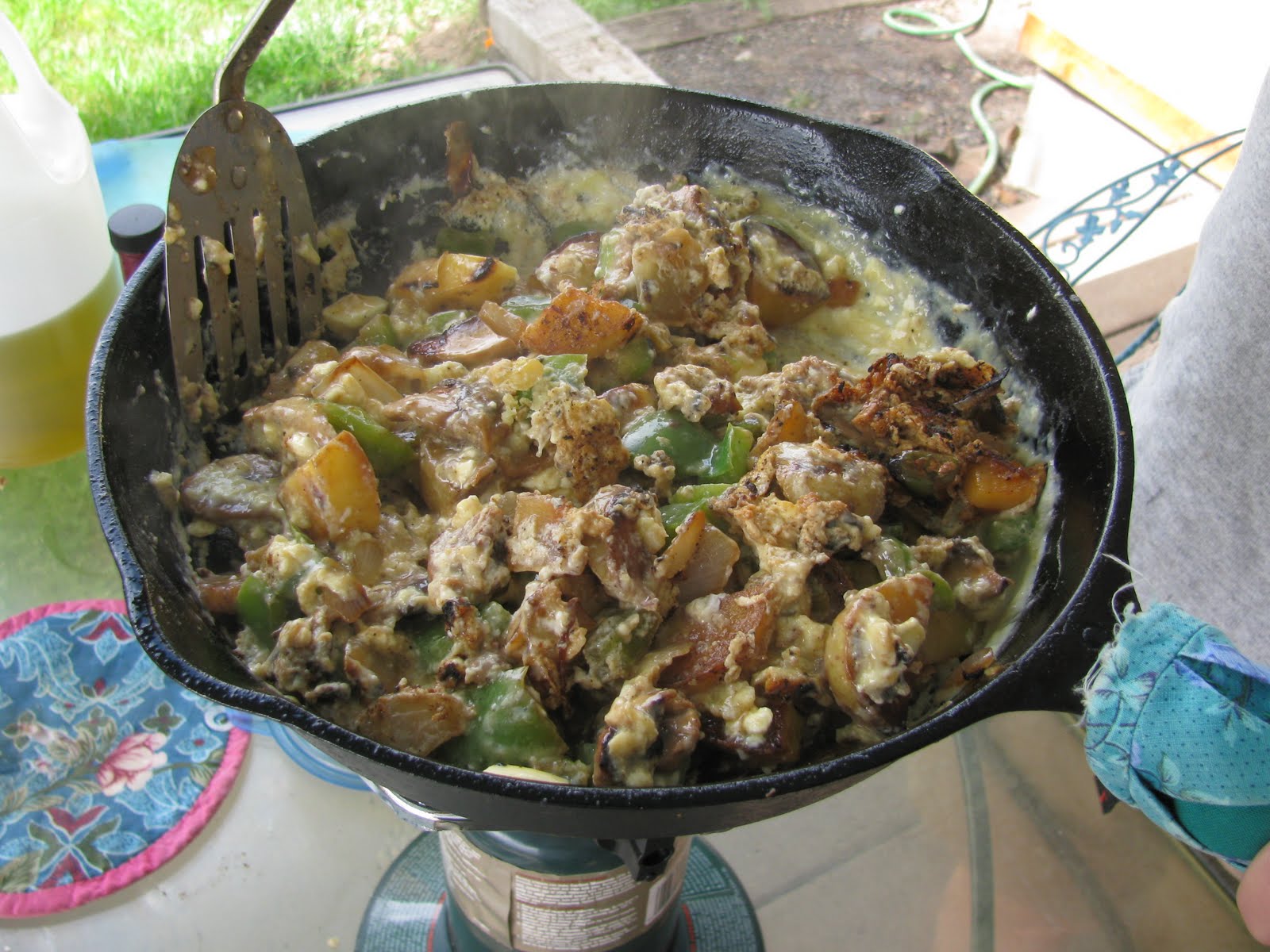
As I get L.E.’s poem together for posting, thought you might enjoy a few pix of the happier parts of the power outage: Eberle’s wonderful breakfast cooked on a small Coleman stove: scramble composed of organic Yukon Gold potatoes, farm fresh eggs from my Farmer’s Market gig, green peppers, onions, mushroom’s, our good friend Heather’s homemade feta cheese, & bacon. This was really good!

Yours truly, by request, sang for his breakfast!

Back shortly with L.E. Leone’s latest Dating Poem!

breakfast songster


kitchen sink?


kitchen!

la pièce de résistance!

Open Range!


It’s been a long time—last August, actually—since I last recounted some tales of country life here in the Idaho hinterlands; I was aimlessly looking thru old scans & saw the pic used in this post & I said to myself, “Self, it’s time you wrote about your open range experiences.”

These days, "free range" is a term in common parlance. Many folks are buying free range meats—& a good thing, I say. But “open range” has a somewhat different, tho related meaning. When I first started visiting Idaho back in 1997, I was struck by all the signs saying “Watch for Stock”—what was this “stock” we were supposed to be watching for? Eberle informed me that “stock” equals “livestock,” & that many parts of Idaho are legally “open range areas.” Wikipedia offers a pithy quote about this:
In open range, it becomes the responsibility of the land owner to keep unwanted livestock off their land and the livestock owner is not liable for any damage caused by the livestock.

That in a nutshell is the Idaho law, tho questions of liability aren’t as clearcut as this might suggest. For instance, if you plow into an angus “beef” (in local parlance) on U.S. Highway 95, you likely won’t be found liable for the cost of the animal—or more accurately, your heirs wouldn’t be liable for the beef, because odds are both you & the beef will have gone where the good folks & good beeves go. To quote poet John Berryman, “this did actual happen” (almost) to Eberle & me; we came around a curve on Highway 95 to see two angus beef cattle standing placidly in the midst of our lane. Obviously, I wasn’t going too fast, or I wouldn’t be here to tell you about it. We swerved & the cattle stood by unfazed. But my favorite free range story goes as follows.

Eberle & I have never finished fencing the entire perimeter of our property—there are a couple of lawns on the dirt road next to our house that are wide open, & as such, they would constitute “open range” both legally & literally (when the cattle drives wend past our place). It was a few years back now, when we had four llamas & an alpaca. It was the fall of the year &, under a very large silver tarp that neither of us could ever quite master, we had our winter’s supply of grass hay stashed away for our Andean beasties.

Someone—probably Eberle—noticed that the tarp was winding up more askew than usual in the mornings & it quickly became clear that there was some form of persuasion involved. In fact, some beef cattle from down the road had found a bad spot in their pasture fence & had sauntered down Indian Valley Road in the middle of the autumn night to have a midnight snack at our place. The next night Eberle & I decided we would do something about this—not sure what, but something!

I don’t recall who woke up at 3:00 in the morning in our old bedroom convinced that our bovine friends had again come calling for a late night snack—or very early breakfast—but I sprang into action. I became the Subaru cowboy.

Yes, I pulled our Legacy down the driveway & somehow managed to use it to “drive” the cattle home—not that they were sitting in the backseat, mind you, but that the took off at a nice bovine lope down the paved road when they saw the infernal machine & its headlights creeping down the driveway. Once they were back in their pasture (admittedly, with a total dysfunctional fence) I turned to the other great cowboy occupation: fence-building. Now, you might ask—how would I build a fence at 3:00 a.m. on a chilly October night. I had my plan!

At the time we had two pick-up trucks—a 1990s Dodge Ram & a 1980s Chevy. I parked the Subaru in its usual spot & back the Dodge Ram down onto the lawn to the east of the hay; then I backed the Chevy down to the west, & finally “parallel parked” the Subaru in the gap—et voilà—I had erected a massive metal fence that probably was of only limited utility, but made me feel a whole sight better about the situation.

The upshot? The rancher fixed his fence & I disassembled mine the next day. More joys of country living (on the open range).

Pic shows cattle grazing on a range allotment in the Payette National Forest, summer 1997

Adams County Makes the News – Introduction – 3

[Part 3 (of 4) of Eberle’s Introduction to Adams County Makes the News]

Myths about rural life abound—the invention of the Wild West is just one of them. I often come across the idea, both among city and country folks, that a rural town is basically like a city, only smaller and less advanced, less sophisticated—that the differences between a city and a rural area can all be accounted for if you simply scale down the urban reality and take into consideration the rural area’s backwardness. To me this is a strange misapprehension, and somewhat mysterious. It’s as if a cloak of invisibility covers the rural experience. On television, for instance, you don’t see many western North American rural towns on commercials that make use of rural imagery—although exotic rural communities are quite fashionable just now (an SUV driving through a computer-generated wilderness to a third world village market.) The Wild West myth surfaces on occasion in commercials that make use of rural imagery—spewing mountain sunsets and cowboys—and in shows, the stereotyped country hick versus city slicker set-up isn’t dead yet. But beyond that, the veil of obscurity falls with an almost audible thud. In fact, it could be that the national consumer market of rural towns is so negligible that rural life is heading toward some kind of media extinction—not necessarily a bad thing. But it would be convenient if there were a word to describe those realities which take place in the shadow of looming myths—the lost Atlantises that are thriving, invisibly, among us—because I think that they exist in abundance.

The individualized and local nature of the Adams County newspaper makes it a unique historical record of the community. Editorials, ads, articles, and letters to the editor have the advantage of
representing with word-for-word accuracy what a certain part of the population cared about at the time—the people who wrote to the paper and the editors of the paper. It would not be accurate to say this represents the community in its entirety, because many people don’t write to the newspaper—the prostitutes, for example, who were reported as having a fight in 1902, were not writing letters to the paper. And there are groups which are completely or almost completely unrepresented—children, for instance, or the workers at the Mesa Orchards. Material sent in to the paper is based on the fact that the writer sees her or himself as existing in some relationship to the community—to a certain degree, because of its public nature, the writing is about that relationship.

The newspaper material doesn’t create a complete record of all individuals in the community, or an exhaustive history of the area, but I find the authenticity of the written gestures that have
found their way into the paper very compelling. Everyone who writes for publication in the newspaper, whether a reader or an editor, shares a similar starting point: the decision to make personal thoughts public. The different voices that are generated by that decision, and the range of motivations that prompt it, reveal various dimensions of private and community life over time. As with any history, what is unwritten creates its own spaces between the lines and is part of the experience of reading. To my mind, the kind of gaps and fragments inherent in the county newspaper narrative create a particularly fascinating landscape, a kind of do-it-yourself novel. There are tempting by-ways, and sudden glimpses of remnants of the past, archways framing vistas from half-forgotten points of view, paths to be taken or left behind.

I found myself, for instance, threading together the history of Iola DeGaris between the ads for her millinery shop and her wedding to the “good-natured and popular meat-cutter… and prominent member of the Council band,” Otto E. Brauer. The fate of two Council boys who meet up at the front during World War I has a dramatic poignancy: one is killed shortly afterwards, and the other turns up later in the paper as the village marshal. In 1931, Charlotte Lemon writes a letter to her father, the editor, upbraiding him for reprinting a sexist article—which made me start wondering about her possible influence on his outspoken editorials calling for women’s restrooms in the public buildings of Council. These fragments of lives are compelling to me because they make me realize how much any “objective” history leaves out—not just individual lives, but the unique context of the relationships that have evolved over time within a community.

Reading the county newspaper, where a wide range of individuals and their relationships are
palpably present, creates a humanizing perspective on that period of history— not always a comfortable experience, as some individual voices, untempered by abstraction, can be disturbing. It is one thing, for instance, to know that some people understood and supported the killing of Germans in World War I as justified genocide; it’s another to see that thought process in action in someone’s own words. I found that my own emotional responses to the various narrative voices became integral to this way of reading the past.

Part of the texture of newspaper material as history comes from the juxtaposition of
details—how to use egg-white for mending, what percentage of school children have tuberculosis, who has a rooster for sale, what constitutes profanity, the Council bank failure, who has grown the biggest ears of corn. The juxtaposition of large and small events hints at a sense of scale that I often find lacking in more traditional histories. There is foreground and background, and randomness, and moments of poetry, which I think of as reality haiku. For instance, “news” sent in to the paper from Indian Valley in 1913:

“It is raining today.
Pastures are quite green.
We hope no potatoes are green this time of year.”

What I like about this is the way that the everyday comes into the record of the past, as expressed in the voice of a writer of that time. Diaries or letters involve that kind of writing as well, but from a single point of view. The newspaper material, on the other hand, offers multiple local points of view, unified by the public intent of the writing and the shared community of readers.

Vanished establishments in Council take on life as well, through the patchwork of newspaper
items. The Overland Hotel, for instance, gone for decades now, advertised pack trains into the mining regions; a woman residing there advertised a two-year old baby in need of a home; the price of meals was published, as well as the dates when a traveling optometrist would be there to see residents with eye problems. Facts that might not find their way in to many histories of the early twentieth century West appear in tantalizing detail—that people used to give cracked bones to their chickens instead of oyster shells, that school outhouses for girls and boys had to be fifty feet apart from each other by law, that a piece of brown paper covered with mutton tallow and well sprinkled with ginger was recommended as a chest plaster in cases of whooping cough.

Pix from Top:
Adams County Rodeo Queens, Council, 1997
(despite jpg name!)
Cattle on the upper stretch of Mill Creek Road, Council, 1997
Carved Bear Art, Council, 2000
Our garden shed, 1998
Council Quilt Show, 1998
Adams County Fair, Council, 1997


Adams County Makes the News – Introduction – #1

[We’re really excited to begin a new long-running series—Adams County Makes the News. This is a manuscript containing letters from the Adams County newspapers from the early 1900s to about the time of World War II; Eberle compiled the collection, & also wrote a most interesting introduction. We’ll begin with Eberle’s intro, which will comprise the first three or four installments before moving on to the letters themselves. Enjoy!]
“Council Valley First, The World Afterwards,” proclaimed the Adams County, Idaho newspaper banner in 1910, with a bit of tongue-in-cheek bravado about its local focus. From early on, the paper exhibits this kind of self-consciousness about its small-town nature—a particular combination of pride and defensiveness that I see as persisting over its history. I walked into the newspaper office in Council a while back as people were discussing moving the old printing press, which has loomed hugely in a corner for many years, to the local museum. I asked Tim Hohs, the editor, if he was going to do a story on the move, and he responded with the recognizable 1910 spirit: “You know our motto here in Adams County: if it happens, it’s news.”

Since 1901, there has been a newspaper located in Council. For its first few years, it was known as the Council Journal, and then as the Council Leader. Adams County did not become a separate entity from Washington County until 1911; during World War I, the paper changed its name to the Adams County Leader, not to change it again until the 1990s. In the seventies, two other papers started up in Council: the Upper Country News, whose existence was brief, and the Council Record. The Adams County Leader merged with the Record in the nineties to become the Adams County Record, and the newspaper has retained that name through the present time. The continuity of the newspaper—its Council location and the stability of the population it served—has shaped the evolution of its unique relationship with communities of readers in the area.

The population of both Adams County and Council has been remarkably stable over time, with
the town of Council having fewer than 1000 inhabitants over the course of its whole history. The entire county has had 3000 or fewer inhabitants. Council, with a population of 816, is still the largest town in a county that does not possess a single stoplight. With Adams County comprising 1370 square miles, sparse population has been an on-going fact in local community identity. Difficult travel conditions meant that many areas (such as Cottonwood, Alpine, and Mesa) used to be more identified as separate communities than they have been since the advent of paved roads. The newspaper would report, for example, in 1910 that: “The Fourth was passed very quietly by most of the Cottonwood people. Earl and Glenn Kiser went to Weiser. Several went to Middle Fork fishing. There was a family reunion at the home of Mrs. Moser, all of her children being present except the oldest daughter.” In 1925, a newspaper reader from Sourdough wrote in: “Why does our (county) sheriff’s office require a permanent deputy at a salary of $900 per year whose residence is at Meadows? Do they need a deputy up there more than we do down here at Sourdough? Is it because their moonshine up there is not as good as ours?”

Even given greater ease of travel, communities in the county retain their autonomy—and come into conflict with each other, on occasion, over that autonomy. Although self-identified over most
of its history as serving the whole county, the Adams County newspaper is subject to periodic complaint that it is too focused on Council at the expense of other towns and communities in the county. One way the paper has addressed the reality of autonomous and far-flung communities is to print, on a regular basis, news sent in from other areas. However, New Meadows, for example, can experience a major upheaval in its city government without an Adams County Record reporter sent to the scene— the 52-mile trip being outside the paper’s current expense budget for travel. The populace of Bear can descend on the county seat in a fury over contested possession of the road to its cemetery or over county trash disposal policies, and express complaints about Council’s lack of understanding of the rest of the county. In the newspaper as well as within the county there is an on-going question about whose voices will be heard and whose ideas about the county’s identity will prevail—this is part of the way in which the newspaper participates in the community’s narrative about itself.

So Adams County, though sparsely populated, doesn’t exist as a single, monolithic community,
but rather as a collection of communities. The low population density also contributes to the fact that communities at the borders of the county have some partial allegiance to the neighboring county—children of Indian Valley attend school in Washington County, for instance, and many residents of New Meadows work in Valley County. When county lines were first being drawn, these varying geographic and social contiguities came into play. Arguments in the newspaper over the drawing of county lines enact these underlying dramas of allegiance as points of crisis in the creation of local identity.

Historically, roads and the railroad occupy a good deal of space as topics in the newspaper. Geography is clearly a powerful force, and shaped the relationship between towns in the larger
region of Adams, Valley, Idaho, and Washington counties more than I would have guessed. I expected to come across early evidence of relationships between the towns in the larger region, but very little in the nature of an active relationship is expressed, except for a recurring spirit of rivalry between the towns—over attracting settlers, over sports and contests, over who gets money for roads, who has a gymnasium, who has contributed most to the war effort. Within the larger area of the county’s interest, there are constantly shifting rivalries and alliances— for instance, on numerous occasions, the newspaper expresses Council’s animosity toward Weiser. In 1925: “To us, hell is just a place; and we used the word in the same sense that one might mention Boise, or perhaps, to be more exact, Weiser, for instance.” But newspaper readers can also be asked to band together with Weiser to face what is perceived as a shared threat, such as during the anti-mail-order-house campaign. Overall, the history of geographic isolation and a sense of very localized identity seem to be more powerful than motivations that would create more active partnership between towns in the region. McCall and Council, for instance, though only 35 miles apart, often don’t even provide information in their present-day newspapers about major local events in the other town.

The early economic history of Adams County is also directly connected to its geography.
Council’s early existence as a town was very much linked to its role as a supply station on the route to outlying mining concerns. Business and agricultural enterprises grew up in the wake of that supply activity, making Council the economic center of the county. Council continued as the county seat, although other towns vied for that honor. Geography proved to be a crucial factor in the failure of mineral extraction in the surrounding mountains to become viable industries. The Mesa Orchards, referred to frequently in the newspaper, were a flourishing enterprise for a while, with expectations of becoming one of the nation’s largest suppliers of apples. They were the source of much hope for the economic future of the area, but declined through the twenties and thirties. Geographic isolation gave the orchard owners an economic edge at first, because they didn’t have to battle the infestations of insects which plagued other orchards in the nation. The arrival of the coddling moth was inevitable when better roads led to increased travel to the area. The costs of insect control and of irrigation proved to be huge blows to the orchards, which were eventually abandoned as any kind of major commercial operation.

Between mineral extraction, fruit culture, fox and fur farms, the railroad, farming, ranching, and the timber industry, Adams County has experienced several waves of boom and bust. In the first decades of the twentieth century, the spirit of hope truly springs eternal in the pages of the newspaper—possible grandeur for the county seems always to be appearing on the horizon during this period. There is a strong belief that Adams County can become “the garden spot of Idaho, and Idaho the garden spot of the earth.”

A remarkable spirit of “boosting” the town persists through all the vicissitudes of fortune. Those
who “knock” the town come in for abuse that can get very personal, and the paper takes on these “knockers” in a serious way. In 1915, the editor writes: “While down at the depot one day last week we heard J. L. Griffith of Payette knocking the Council Valley as hard as he knew how in the presence of a homeseeker whom one of our real estate men was about to close a deal with. On coming up the street we were told that Mr. Griffith had been doing a lot of knocking which we did not hear. He was very imprudent to say the least. Mr. Griffith sells tombstones and he has practically a monopoly on the business in this part of the country, but such talk as he made on his last trip will certainly erect his business tombstone in this vicinity in short order. The people will not exert themselves to give their patronage to such knockers.” The way that the newspaper addresses individuals—with the understanding that its readers will know, personally, who these individuals are—is part of its community-created rural identity.

Eberle Umbach
© 2003-2010

Pix from top:
The Adams County Leader Building:
January 10
The Outskirts of Council looking toward the eastern foothills: August 08
Bear School:
May 99
Hay Bales in a Shelter, Indian Valley: November 09
The Old PIN rail line, now a Rails to Trails conservancy, in Glendale: October 08
Horses & colts with a view toward Mesa Hill: June 07
Adams County Rodeo Parade in Council:
July 98


submit to reddit

Weiser River Pillow Book #14


[Here’s the final installment of Eberle’s Weiser River Pillow Book—although some editing has been done along the way, the majority of the work is now available on Robert Frost’s Banjo, & the link to this writing will continue to appear in the sidebar for the foreseeable future.]

THINGS THAT SHOULD BE SHINY

The fake mother-of-pearl buttons on a rodeo shirt.

Windows on a mirrored glass skyscraper. When these are not shiny, it appears that the whole purpose of progress has failed.

Blackberries picked in late summer.


THINGS THAT SHOULD NOT BE SHINY

Cars.

The interior of a church.

The front doorknob of a house surrounded by trees.


SQUALID THINGS

The smell of an empty school corridor lined with lockers above which are student drawings of ways to save the environment.

A trowel that has rusted with dirt still on it.

Chicory that has flowered close to the ground after being mowed.

An unmatched sock.


THINGS WORTH SEEING

Magpies landing outside the kitchen window after the first snowfall.

On the floodplain of a river, an abandoned house through which vines are growing and covering half the roof with leaves.

A county fair where there are many kinds of poultry and pigeons, also goats.

A forest three years after a wildfire has passed through it.

You are walking through the woods thinking how silent it is and how alone you are, and then you notice at the base of a huckleberry bush, a hairbrush, ruined by weather, the gold lettering on its back almost legible.


THINGS THAT MAKE YOU THINK OF SOMETHING ELSE

The sound of a refrigerator late at night can bring an aquarium to mind—the tiny bubbling treasure chest and diver never reaching it—the trapped light.

It is the middle of summer and you know there is no chance of rain. Nonetheless, a truck going by on the highway makes a sound like thunder and for a moment you shiver deliciously.

When the cottonwood trees are releasing cotton in the spring, it does look like snow in the air and yet does not bring winter to mind.


ODIOUS THINGS

The plastic countertop where it has come loose from the edge of the kitchen sink,

The "Sealed For Your Protection" seals on aspirin and chopstick.

At a community meeting, sitting next to someone who bites his nails.

Gas stations and restaurants that are part of national chains, erupting in the rural landscape like the signs of an inevitable disease.


HAUNTING THINGS

The image of oneself as a child.

On the verge of sleep, repeatedly, being awakened by imaginary alarm cries coming from the guinea hen coop.

When the sun has almost set behind the highway, a passing truck blocks the last of the light and the house goes dark for an instant longer than a blink.


THINGS THAT ARE NO BETTER THAN THEY SHOULD BE

The mop bucket.

Crocuses after their first bloom, especially the large kind.

One's girlhood crushes.


THINGS THAT ARE AT HOME IN THE WORLD

A robin standing on a fence post.

An old seeder rusting on a hillside above abandoned fields.

A dinghy moored in the small pool of a rock-crushing pit.

The desk and window in my studio.

An eagle's nest on top of a power pole.


THINGS THAT LOOK GOOD IN JARS

Dried beans—especially black garbanzos and striped lima beans you have grown yourself.

Star anise.

Pickled beets.

Coriander seed from the garden.


THINGS THAT DO NOT LOOK GOOD IN JARS

Pig's feet.

Scientific specimens of any kind.

Leftover tomato paste.


THINGS THAT GIVE THE SENSATION OF FALLING

Standing in a supermarket aisle surrounded by varieties of canned tomatoes that seem to have proliferated since the last time you were there. Varieties of breakfast cereal also create this sensation; varieties of tea, however, do not.

Thinking about a phone number you have lost.

Being about to fall asleep and waking suddenly.


PAIRS THAT GIVE PLEASURE

When the leaves of the cottonwood trees by the side of the highway are the exact same shade of yellow as the double line.

When the line of a jet trail in the eastern sky is the same color as the clouds around the setting sun.

How sometimes I hear the traffic on the highway above my house and it sounds just like a river.

Eating pears and grapes together.


LARGELY UNRECOGNIZED MASCULINIST ASSAULTS ON THE WORLD

All music on the radio.

All systems of measurement.

Women who give their children the last name of their husbands.


THINGS ON A GIANT SCALE

Rolls of hay stacked in shelters; three rolls on top looking like an enormous clover leaf.
Erosion on the side of a small hill can create the impression of a massive distant mountain range seen from above.

Near the spring that feeds the house under a wild plum tree, there is an ant-mound that is two feet high. In itself it seems strikingly large; still, the yellow plum leaf resting on it looks huge.


TWO TOWNS NORTH OF HERE

There are many more new cars. There are stores selling clothes for outdoor recreation.

There are no magpies, quail, or black widows. Very few cottonwood trees, lots of pine trees.

In the streams, caddis flies use bits of pine needles in their shell-casings.


INEXPLICABLE THINGS

Electricity.

When continuing a diary in a new notebook, the desire to make a gesture of formal introduction of some kind, however subtle or oblique. To whom?

The pleasure of shining the old chrome-covered clock-timer on the stove. It doesn't work, is not attractive, and yet the tenderness I feel for it never fails to spring up when I’m cleaning the stovetop.


THINGS DESIRED FOR A WHILE BUT NOT ACQUIRED

A clothesline.

An extra steak knife.

Two large steel-covered bass drums.


THINGS DESIRED FOR A WHILE AND RECENTLY ACQUIRED

A blue enamel bucket to hold scraps for the chickens.

A medium-sized doumbek.

A jumper for fall. The perfect fall jumper is of medium weight, very soft, not binding anywhere. Long enough to give a feeling of serenity but still allowing for easy motion. It should not create a feeling of loudness or of primness.


THINGS THAT MARK A POINT IN TIME

Planting garlic.

Taking down the hammock.

Putting hats and mittens in a basket on the dryer.

Eberle Umbach
© 2000-2010


submit to reddit

Snowbound Sugar Cookies

When you last saw Eberle & I in our kitchen, we were snowbound & preparing her delicious pumpkin stew. However, that wasn’t the end of our cooking adventures on that snowy Tuesday—of course not, because as delicious & hearty as that pumpkin stew assuredly is, it doesn’t cover the most important course, which is dessert of course.

I’ll start out by saying that our cookie baking is a humble recipe, tak
en from an old & well-beloved copy of the Fannie Farmer Cookbook—also the source of my macaroni & cheese recipe (& its attendant white sauce), my gravy recipe & several of Eberle’s more elaborate baking recipes. What makes these cookies stand out is the freshness of the ingredients. If you recall, we have a couple of students who pay for music lessons in commodities like milk, butter & eggs—you can see that right there we’re already on the way to some fresh & tasty cookies!

The ingredients are simple:

½ cup of butter
1 cup of sugar
1 Tbsp of cream or milk—we used a half & half mix, all from Sonia, our favorite Jersey cow
½ tsp of vanilla—real, please
Sometimes we add a ¼ tsp of lemon or lime juice; we didn’t this time simply because we didn’t have any. The cookies are good either way.
1 ½ cups of flour—unbleached if you have it
¼ tsp of salt
1 tsp of baking powder

That’s it. Pre-heat your oven to 375. Then you cream the butter—now just check out that farm
fresh butter from Sonia the cow in the pic!—& following that beat in ¼ cup of sugar. I have to make a bit of an aside her. Last summer our friends Sally & Erich & Anna Lu came to visit us from SoCal. Eberle was baking something—I forget what now, tho whatever she bakes is great—& it fell upon yours truly to cream the butter. At this point in time we didn’t have a mixer of any sort beyond a fork & elbow grease; I’d asked Eberle if she wanted a mixer, but she’d always said she didn’t. I can tell you, friends, after that experience of creaming the butter with a fork, I bought a mixer the very next day at the local supermarket—you can see me wielding it right here.

Beat your egg, then add the cream or milk, the vanilla, flour, juice if you’re using it, flour, salt & baking powder. Drop the cookies on a buttered baking sheet & bake until golden (but watch the bottoms lest they get too crispy!)—should be around 8-9 minutes. I think you all can take it from there!

So obviously this is a recipe practically anyone can make—but I think the point here is something in addition to this simple but very effective cookie recipe, & that's the concept of “know your farmer, know your food.” I know this is a kind of rallying cry amongst food activists, & it makes a lot of sense—in terms of food safety, in terms of resources & in terms of flavor, too. This country doesn’t eat well: I think that’s a fact that’s acknowledged by all but the most hidebound amongst us. Not even getting into the scourge of fast food & soda pop, there are a lot of
overly processed foods out there, milk that's amped up on hormones, apples covered with wax & pesticides, & high fructose corn syrup anywhere it can be added. The problem with supermarket organics is frankly, they're often prohbitively expensive; & as an aside, have you ever looked at the chart in the supermarket line of how many healthy foods are covered by food stamps?

A couple of practical answers to this: folks can band together & buy healthy food at bulk prices
thru a number of health food stores &/or mail order services. But even more to the point: if you're fortunate enough to live in an area where there are still small family farms, please do yourselves & these small farmers a favor & consider patronizing them for whatever staples they have available—buy their produce at farmer's markets & similar outlets. Take advantage of resources like community gardens. Also, grow your own, because that's really know your farmer, know your food.

Snowbound Pumpkin Stew

January in Indian Valley is not the most auspicious time of the year, by my calculation at least. Indian Valley is prone to inversions & (frozen) fog in the winter, & can get quite cold & snowy, tho how cold & how snowy can vary pretty significantly from one year to the next. This year so far: colder & more snowy than a lot of them.

This has resulted in a few days of being “snowbound”—snowed-in, driveway too big for either of us to shovel & our fellow who plows is very reliable, but can only get to everyone just so fast. Yesterday’s 1 to 3 inches of predicted snow managed to triple at the high end, & there you have it. A driveway impassible even to our reliable (but relatively low clearance) Subaru Outback.

Of the many activities you can undertake while snowbound, cooking is one among the most
enjoyable, & so yesterday afternoon, Eberle & I decided to whip up a batch of her wonderful pumpkin, black bean & sausage stew. Doesn’t that sound great? Well, we’ll get to the details in a moment, but first some back story.

As anyone who’s read this blog at all knows, both Eberle & I are music teachers in a very rural area. This has led us to some creative solutions in terms of payment: to make a long story short, at this point, we’re getting eggs, milk, yogurt, butter & blue cheese(!) all farm fresh/handmade, & we recently came into some homemade, farm fresh sausage & some lovely pumpkins. I think you can see where this is leading—lots of fresh ingredients in this recipe & the follow-up one that will appear next Wednesday!

OK, so whether you’re ingredients come from a local farmer or the supermarket, here’s what you need:

1 pie pumpkin. As Eberle says, pumpkins are easy to grow, easy to store, & once cooked, can be frozen. They used to be a staple food, &
not just the seasonal jack o’lantern or pie filling. My taste buds actually prefer pumpkin to most winter squash.
1 cup dried black beans, or one can of same. Soak your black beans overnight if you’re using dried beans.
sausage or bacon—I don’t give a weight because there was no weight on the package of homemade sausage we used; as you can see, it was a pretty substantial amount. If using bacon,
probably about 6 strips would do.
1 dried hot pepper—we like the smoky chipotle
1 onion, roughly chopped
about ¼ cup of either cooking wine or red wine vinegar. In our case, we used Eberle’s homemade
vinegar. She made her own mother of vinegar a couple of years ago from our homegrown pears, apples & plums!
a dash of orange juice—you can use lime juice instead or in addition to
a dash of BBQ sauce—the secret ingredient!
1-2 tsp of chili powder; we used two, but you can make it milder if you prefer.
¼ tsp cayenne—again, this is to taste
¼ tsp cumin
1 pinch of cinammon

Pre-heat your oven to 350, then start in on the pumpkin (this is assuming the beans have been
soaked, or that you’re using canned beans). Knock the stem off the pumpkin using the handle of a large knife. Then, using the tip of the knife to start, cut the pumpkin in half & scoop out the seeds & string with a large spoon. Place the pumpkin face down on a baking dish & cook for approximately 25 minutes—the real test is that the pumpkin is done when it’s just a bit more firm than fork tender. Let the pumpkin cool before working with it further! Once the pumpkin is cool, cut it into slices, & peel it by cutting away the flesh (as Eberle is demonstrating in the photo.)

Simultaenously with this, you can cook your black beans until they’re tender, about an hour. When the beans are done, reserve the bean stock—
you’ll be using it later. Begin to sauté the sausage—it will be sautéed until brown. Soak your dried hot pepper in water (about 15 minutes should do the trick), & chop that onion. When the sausage is brown, add the onions. Sauté the sausage & onions together for a few minutes, then add the cooking wine or red wine vinegar, the orange (&/or lime) juice, the BBQ sauce & the spices.

Now it’s time to work with the pepper—be sure to wear latex or rubber gloves! Remove the stems, slit & wash out the seeds as Eberle is demonstrating in the photo, then add the pepper
to the sausage & onion, & finally add the sliced pumpkin. Sauté all these ingredients together for several more minutes. Then, cover the sautéed ingredients with bean stock & cook on a low simmer for about 20 minutes. This operation may involve transferring the ingredients first to a larger pot or skillet if, like us, you began with a relatively small skillet! Then add your cooked beans & gently simmer for approximately 10 minutes.

This stew goes well with cornbread (of course) & would also be complemented, I think, by a spinach salad topped with real blue cheese dressing. Just the thing for a snowy winter’s afternoon or evening!

Stay tuned, because next Wednesday we’ll have more snowbound cooking adventures!

Weiser River Pillow Book #13


[Here’s the December installment of Eberle’s Weiser River Pillow Book, & good news for Pillow Book fans: there’s enough left over to make one more post in January. Hope you enjoy it!]

THINGS THAT DISTANCE CHANGES

The new black boots I bought in Boise look remarkably sophisticated by the time I arrive home with them. And the vinegar and spices that were tiresome to buy in a crowded store take on a hint of Arabian treasure when they are unpacked in the kitchen a hundred miles later.

Bittersweet picked in Massachusetts, now in a vase by my keyboard.

In Pernumbuco, a colorfully printed package of herbal tea that arrived from the States; it was the packaging that seemed unbelievable, such delicate designs; the tea itself was unremarkable in a place where you step outside the door and gather a handful of lemon-grass and orange leaves for tea.


THINGS THAT DISTANCE DOES NOT CHANGE

A miniature white carriage from Chinatown looked as exotic in San Francisco as it does on my bookshelf.

Doritos, Pepsi, Milky Ways—the food items that have infiltrated the highway system and look the same everywhere.


ARDUOUS THINGS REMEMBERED FONDLY

A man talked to me of spending a winter 30 miles from the nearest passable road; his eyes gleamed when he spoke of shoveling snow off the roof of his cabin.

I smile when I remember hauling water in Pernumbuco from the cistern in a wooden-handled bucket to take a shower using a tin cup.

When I go out before dawn with water for the poultry, I usually hate it until I'm halfway across the snowy path and then I feel a particular elation.


THINGS THAT CLUTTER THE MIND

Dreams that are filled with anxiety, but not quite nightmares.

Having to think about work-for-money, especially the people you must think about.

Social interactions where you are not sure you have acted appropriately.


THINGS THAT PARALYZE THE MIND

Old wounds, from family.

Tiredness.

Worries about money.


THINGS THAT FREE THE MIND

Daring.

Nonsense.

Laughter.


THE LARGEST MOVING THINGS

Manufactured homes being trucked on the highway.

The Life-flight helicopter on its way to Boise.

Trucks carrying two layers of cars.

Fog rolling in.


THERE IS NO WAY TO REMEMBER EXACTLY

There is no way to remember exactly from year to year how beautiful the plants become when fog has frozen on them. There is a tall stem of chicory on the north side of the house I kept forgetting to pull out last summer. It is transformed now with delicate crystals differentiating its varied surfaces. Instead of being an annoying, presumptuous presence, it is a surprise, like a present—incongruous but delightful among the everyday things.


I DREAMED THERE WAS A COUGAR

I dreamed there was a cougar in with the guinea hens, also a tiger and its baby. The cougar ate the tiger's baby. The cougar was full, the tiger was mourning, and so the guinea hens were not in danger—but there was no sense of safety.


ONE THING I LIKE ABOUT WINTER

One thing I like about winter is the sense of doing battle. But this troubles me. I can so easily imagine early Germanic peoples telling stories of war in front of a fire in the winter months. It is the essence of abstraction—tales of war becoming cozy as the snowstorm rages outside and inside the stack of wood is high. The rest is European history.


BEWARE THAT SENSE OF VIRTUE

Beware that sense of virtue which comes from watching the sun rise—smugness creeps in on the superstition that you helped it.


THINGS CAUSED BY TOO MUCH WORK FOR MONEY

Buying too many things.

Many stress-related illnesses; a loss of personal identity, values, and sense of beauty.

After too much word processing, a dream where I see the formatting of my mind in a Reveal Codes screen.


ALL I HAVE IN MY HEAD TODAY

All I have in my head today is music. The writing I'm working on could not be farther from my mind. Everything in my head organizes itself into rhythmic units of 2's and 3's, building into 8's, into 12's. The leaves on the ground where they appear between patches of snow are doing it, the straw bales, the clumps of bushes against a white hill, everything is doing it—as if an audible pulse in my mind is going through my eyes and becoming visual.


STRANGE HOW THE WORLD SEEMS BRITTLE

Strange how the world seems brittle when a layer of fog closes in just behind the line of the closest hills. There is an illusion that things have gone two-dimensional and, if struck, would be shot through with tiny cracks.


THINGS THAT ARE GOOD TO HOARD

Days with no social or work-for-money commitments.

Bubble bath, in winter.

Buttons of all kinds, especially old ones, and pieces of cast iron from the dump for garden ornaments.


SIGNS OF THE WINTER MIND

You can spend the entire day making up drum rhythms.

You notice that the lace edge of a curtain is grimy with dust and your reaction is complete despair.

You forget to call your friends for days at a time.

Wanting large hunks of meat in the freezer.

Wanting to read Herodotus.

When the shape of the satellite dish is the only distinct marker in the freezing fog and you look up eagerly at the appearance of the flashing lights of the county plow as if a sister ship is passing your drifting house.

When you and your partner are talking about how to repair the water-damaged ceiling and feeling acutely aware of the lack of money, the lack of work, and a sense of bleak reality is mounting—and then there comes a loud sound of scratching from under the floorboards. You both fall silent and look intently at the floor. The sound is being made by something way bigger than a mouse and it is accompanied by gnawing. For some reason though, you both start laughing and the bleak reality disappears completely.


MY FRIEND TALKS ABOUT A GRAY STUCCO HOUSE

My friend talks about a gray stucco house she saw that had vines trained up the walls. Now in winter, she says, the brown lines of the stems and the blue berries looked perfect. Her sense of beauty is terrifying to me because it demands the subjection of everything to an ideal that is so exacting—the berries could not be red, the stucco could not be new, the stems could not be half-green half-brown. Who could live in a house that had attained such ruthless perfection? This kind of ideal is always seen from outside, by an authority that roams ghostlike, disassociated and judging. This is not a ghost I would choose. It would make life like a cliff-edge, it would make the stakes so high, and for what? Ultimately, art can't be based on snobbery, it just doesn't work out.


WHEN THE SUN COMES BACK AFTER DAYS OF FOG

The craters that appear in the crusted snow are lunar in their sudden focus and make you giddy.

The dead grass looks sharp—at first, everything looks dangerous with the glitter and knife-edge of frost. You don't quite want to go outside at first.

For a moment, there is the illusion that everything has become glass and could shatter, could fall in fragments and disappear.

The stop-sign up on the rise where the road meets the highway flashes out like a shield in a return from battle.

Eberle Umbach
© 2000-2009


submit to reddit

Indian Valley in Pix #4

We’re coming down out of the lonesome rangeland & back into civilization—soon we’ll be home. These photos are a bit of a time machine now, as winter weather has come into the Valley a bit earlier than many years. Hope you enjoy this last look at the late autumn landscape—until next year!


The intersection of Grays Creek Rd & North Grays Creek Rd

A sign of the times: the fenced-in road on the mostly unpopulated Gray’s Creek Meadows subdivision

Curious cattle

Resplendent bitterbrush

Calf & cow

Looking west toward Mesa Hill from North Grays Creek Rd

Looking south back into the Valley from North Grays Creek Rd

Curious sheep on a nearby ranch

Heading down the hill back toward our house, we again look south toward the Valley