Happy Monday! & we’re having a very Robert Frost’s Banjo day around here, because we’re presenting both poetry & music.
Since first hearing Natalie Merchant’s extraordinary Leave Your Sleep album earlier this year, one of my favorite selections has been her setting of Gerard Manley Hopkins’ poem “Spring & Fall.” I’ve had it in mind to post the poem along with a video of Ms Merchant’s setting as soon as a good version became available on YouTube. The other day I found just such a video; please give it a listen—it’s remarkable music. In case you missed it earlier, you can read my review of Leave Your Sleep right here. If you do check out the review, please note that since I wrote that I’ve come around to liking “The King of China’s Daughter.” In fact, this remarkable album continues to amaze & inspire me—it certainly stands up to repeated listening! The poem itself, I give without comment—it’s too true & beautiful to explain away. But I should note that Hopkins placed accents over syllables he wanted stressed.
Hope you enjoy Hopkins’ poem & Merchant’s music!
Spring and Fall to a young child
MÁRGARÉT, áre you gríeving Over Goldengrove unleaving? Leáves, líke the things of man, you With your fresh thoughts care for, can you? Áh! ás the heart grows older It will come to such sights colder By and by, nor spare a sigh Though worlds of wanwood leafmeal lie; And yet you wíll weep and know why. Now no matter, child, the name: Sórrow’s spríngs áre the same. Nor mouth had, no nor mind, expressed What heart heard of, ghost guessed: It ís the blight man was born for, It is Margaret you mourn for.
Happy Saturday! I thought I’d share a bit of music with you today, & since this is Robert Frost’s Banjo, why not some banjo music?
In the distant past (all of two years or a tad less), I wrote about the banjo playing technique known as “frailing” or “clawhammer.” For those who aren’t familiar with banjo playing, it involves striking down on the strings with the fingernail of either the index or middle finger, while also using the thumb to either play the drone string or else “drop” down onto the four other strings & play parts of the melody. Frailing is an African technique that came across on the slave ships along with the akonting, or original African banjo. It’s a very rhythmic & percussive style, & is still used commonly in what these days is called “old-timey” music (as opposed to bluegrass, which features quite a different style of banjo playing); it’s also long been favored as a style for dance accompaniment because of its rhythmic drive.
I’ve dabbled in clawhammer style playing, tho for the most part I have a sort of idiosyncratic banjo playing style—perhaps the sort of thing you’d expect from someone who learned guitar fingerpicking for playing old blues & ragtime. But tho I’m not a clawhammerist myself, I do love to listen to this style. There are a number of talented practitioners these days, but one player I especially like is Cathy Moore of the (now apparently dormant, sad to say) Banjo Meets World blog.
Ms Moore is an excellent musician, tho as far as I know, she has never issued any recordings beyond those found on her blog & her super YouTube channel (also called Banjo Meets World) Ms Moore’s playing is—as frailed banjo music should be—filled with pulse & drive, but it’s also crisp & melodic. She also often ventures outside the standard 2/4 timing of most clawhammer banjo music, playing a number of pieces in “odd” time signatures such as 7/8, 9/8 & 11/8. The song I’m featuring, “Trâgnala Rumjana” is, according to Ms Moore’s notes on the video, “A Bulgarian song in 7/8 played over the scoop on my Gold Tone OT-800 banjo.” For the uninitiated, a “scoop” is literally a scoop out of the bottom of the fretboard—it’s found on a number of banjos, especially the openback models favored for frailing, because a lot of frailing/clawhammer players tend to play with their right hand above the fretboard as opposed to the banjo drum.
Speaking for myself, I do hope Ms Moore, who has been silent both on her blog & her YouTube channel, is ok & still playing the banjo—I’d also add that if Cathy Moore ever wants to record an album, I’d definitely get in line!
Hope you enjoy this.
The pic shows a Gold Tone OT-800 banjo—nice machine!
Happy Friday, everybody! We’re here once again with Homegrown Radio featuring another fine song from Scotty Houston. Let’s see what Scotty has to say aout this week’s song, “Love By Wire.”
I thought I'd try something different this week. I'm usually pretty slow at both writing and recording, but this one was about two hours from idea to 4 track to mp3 (still pretty snailish for some folks I suppose, but that's about as sudden as I can get).
A simple uke lullabye sung to another song, so to speak. Genuine Oakland traffic noise here and there.
Thanks, Scotty! Hope you all enjoy this one (&, don’t forget, you can also listen to Scotty’s two earlier songs in the same mp3 player!)—& please don’t be shy about leaving Mr Houston a comment!
Happy Monday, everyone! It’s a Musical Monday on Robert Frost’s Banjo, & a special one at that, as I’ll be writing about some truly superlative & inspirational musicians, the Carolina Chocolate Drops.
If you’re not familiar with the Carolina Chocolate Drops, you are in for a treat—there are two videos at the bottom of the post that will introduce you to their sound. I must confess: one of the hardest things about writing this post was limiting myself to two embedded videos—the Carolina Chocolate Drops are so good & so versatile, & fortunately for all our listening pleasure, YouTube has a generous selection of clips from various live performances.
The Chocolate Drops is the trio of Dom Flemons, Justin Robinson & Rhiannon Giddens, tho they expand at times to include percussionist Sule Greg Wilson, Giddens' sister, singer & poet Lalenja Giddens Harrington, & also their mentor & inspiration, octogenarian old-time fiddler Joe Thompson. You can read more about their connection with Thompson, which is seminal to the band's existence, on their band bio page here.
In brief: the members of the band met at the Black Banjo Gathering in Boone, North Carolina in 2005, & as a result they began visiting Thompson for frequent jams accompanied by much learning about the heritage of this music—& this idea of heritage is important: in fact Heritage is the title of the Chocolate Drops’ superlative 2008 release on Dixiefrog. Pigeonholing music into “genres”—largely a maketing device of the recording industry—does many things; one of those things is create a history that folks take as being true. I once told a young banjo student of mine that the banjo is African in its origin: he was shocked, telling me he thought they’d been “invented in Tennessee.” One thing that genre creation has done to old-time music has been to create artificial divisions that are anachronistic. For instance, what do we make of the fact that Jimmie Rodgers, the “father of country music” recorded with Louis Armstrong & Lil Hardin? It’s convenient to see old time music as dividing along racial lines: what’s now called “old-timey music” (think fiddles & banjos—despite the latter instrument’s African origin) is “white,” while blues & jazz are “black.”
In fact, the real situation in “old-time” music in the old times themselves was much more complicated. I’d vaguely known that there was a strong African musical connection with old-time fiddle tunes, but hadn’t known much in detail until I read Elijah Wald’s excellent book Escaping the Delta: Robert Johnson & the Invention of the Blues (note to self: will write about this on the Banjo soon!) Wald points out that there were many African-American string bands, that African-American communities participated in square dances or “frolics,” & that the fact that African-American string bands weren’t recorded, while European-American string bands were, actually says a lot more about the biases of the early recording companies & field recorders than about the prevalence of musical styles in various late 19th & early 20th century southern U.S. communities. For instance, the band's name comes from the 1930s African-American string band, the Tennessee Chocolate Drops. The Carolina Chocolate Drops are articulate about these problems with music history, & a big part of the band’s mission seems to be raising consciousness about this heritage. However, I must stress that the Carolina Chocolate Drops are far from “mere” revivalists—as Justin Robinson has said, “Tradition is a guide, not a jailer. We play in an older tradition but we are modern musicians.” They are modern musicians indeed—not to mention being classically trained (for example: Giddens studied operatic singing at the Oberlin Conservatory); their Facebookpage lists influences ranging from the Mississippi Sheiks to the New Lost City Ramblers to the Notorious B.I.G. Robinson, for instance, can switch from hot old-time fiddle playing to beat boxing, while Giddens can move with ease from an old blues like “Wayward Gal” (see below) to her show-stopping cover of Blu Cantrell’s “Hit ‘Em Up Style.” While their repertoire is old, it comes beautifully alive in their music making. The clip of “Don’t Get Trouble in Your Mind Below” should provide all the evidence you need of both their vitality & their virtuosity.
In addition, all three band members are versatile. Dom Flemons is a wiz on guitar (typically resonators—a man after my own heart); one thing about Flemons guitar-playing: he knows that the guitar in this music is at least half percussion instrument—listen to the effects he gets on “Wayward Girl.” Amazing! As someone who has had to put a lot of effort into bringing percussion into his own blues guitar playing, I have a lot of admiration for Flemons’ technique. But his prowess doesn’t end with the guitar. He plays a unique but highly effective form of frailing on a four-string banjo, he can really blow a jug (this is no mean feat—& Robinson is also a good jug man), & play the harmonica, bones & snare drum, & he has a powerful singing voice that's comfortable in several old time styles. Giddens is an excellent clawhammer banjo player & also plays a mean fiddle; & she can really play the kazoo—if you’ve ever wondered if the kazoo is a “real” musical instrument, just check out Giddens play one on “Memphis Shakedown” or “Your Baby Ain’t Sweet Like Mine.” Her singing is pretty much transcendant. Robinson, meanwhile, plays an exquisite & energetic fiddle as well as the autoharp, & also plays the banjo occasionally, in addition to blowing the jug & beat boxing. Robinson’s vocals are always a delight, & can range from an exuberant old-time style to something as dark & soulful as "Kissin' & Cussin'" on their 2010 Genuine Negro Jig.
As was the case when I profiled the Mad Tea Party last month, I’m stuck on which of the Carolina Chocolate Drops albums to recommend if you want to check out just one as an introduction. They currently have four available, plus one (Colored Aristocracy, Music Maker) from an earlier incarnation of the band, called Sankofa Strings. The four cds are Dona Got a Ramblin’ Mind (Music Maker); Heritage (Dixiefrog); Joe Thompson and The Carolina Chocolate Drops (Music Maker); & Genuine Negro Jig (Nonesuch). I should mention that Dom Flemons also has two solo albums out—all of these can be purchased thru the band’s website, & most are available on iTunes. If pressed to give an answer, I’d narrow it down to Heritage & Genuine Negro Jig & suggest one of two things: flip a coin or decide you really need both!
This is great music—some of the most inspiring I’ve heard in a long time. Please check out the Carolina Chocolate Drops!
& forces it to surrender." These are the words emblazoned on Pete Seeger’s banjo. & today as I thought about how anyone might respond not only to the enormity of 9/11/2001 but also to all the enormities that have come in the wake of that day—including the enormity of those who are using this year's anniversary to further hatred, division & polarization—as I thought about those things, I kept thinking about Pete Seeger’s banjo.
Pete Seeger is a true American hero in my mind—a man of immense moral courage & a patriot in the deepest sense of the word. One of Johnny Cash’s finest moments was when he defied the blacklisting of Seeger & had him as a guest on his show—& stated his opinion for the cameras, in the midst of the late 60s turmoil—that Seeger was one of the most patriotic men he knew. I agree.
But more important: Seeger’s message. I’m not a Christian, nor even a “believer” in any religious sense of the word, but I must say I’ve never found the phrase “love your enemies” to be particularly ambiguous.
Regarding this, I found the following excerpt from Gustave Gilbert’s interview with Herman Göring during the Nuremberg Trials to be both illuminating & chilling:
Göring: Why, of course, the people don't want war. Why would some poor slob on a farm want to risk his life in a war when the best that he can get out of it is to come back to his farm in one piece. Naturally, the common people don't want war; neither in Russia nor in England nor in America, nor for that matter in Germany. That is understood. But, after all, it is the leaders of the country who determine the policy and it is always a simple matter to drag the people along, whether it is a democracy or a fascist dictatorship or a Parliament or a Communist dictatorship. Gilbert: There is one difference. In a democracy, the people have some say in the matter through their elected representatives, and in the United States only Congress can declare wars. Göring: Oh, that is all well and good, but, voice or no voice, the people can always be brought to the bidding of the leaders. That is easy. All you have to do is tell them they are being attacked and denounce the pacifists for lack of patriotism and exposing the country to danger. It works the same way in any country.
We may not all have the fortitude of someone like Pete Seeger, but we can all in small ways try to “surround hate with love & force it to surrender.”
Happy Friday, everybody! Hope you’ve got your music ears on, because of course it’s time for another installment of Homegrown Radio with Scotty Houston. Let’s see what Scotty has to say about this week’s song:
Believe it or not, I didn't hear Music From Big Pink until it had already been out for about 40 years. Damn it. It's nice to save dessert for last, but it breaks my heart that I missed out on that record for so long. I wrote about 3/4 of this song last year and finished up this week (a deadline is a great motivator). It's a crack at something in the style of The Band but of course it ends up sounding like me. I really didn't want to have a title as lazy as "Roll On" but I would have no idea what else to call it. Lyrically, it's less song about death than it is about rest after weariness.
Regarding the "homegrown" aspect of this week's recordings, the picture I sent last week tells the story: super low-tech. A Tascam DP-004 (the modern incarnation of the classic cassette four track) using only the built-in microphones, a cheapo effects box, and instruments. Four tracks, some bouncing, no punch-ins, and just the mixing I can do manually on the four track. There's no computer schmiz except to send the mix to a file at the very end.
Thanks, Scotty! Hope you enjoy the music—remember, you also can listen to last week’s song, “Next the Barometer” embedded in today’s DivShare player.
It’s a real treat to bring Scotty Houston to Robert Frost’s Banjo as the September artist for our Homegrown Radio feature. I’ve known Scotty since he moved west in the 1990s to play electric bass in Carrie Bradley’s band, 100 Watt Smile. He’s a witty & down-to-earth guy who happens to be a fantastic musician—proficient not only on the bass, but also lap steel, guitar & baritone uke (see photo.)
Scotty has played in a number of bands in addition to 100 Watt Smile. Most recently he was a member of Oakland’s The Mighty Lynch Pins, which disbanded not long ago. Although Scott is currently without a band, a musician of his talents (especially a bass player!) won’t be so for long. You can read more about Scotty Houston on his Robert Frost’s Banjo Musical Questions interview here.
In the meantime, we get to enjoy Scotty’s music as a soloist. In fact, I should mention that Scotty gave me the idea for Homegrown Radio; on his Overjoyous blog, he posted a song a day during the month of May, & while I was enjoying those songs, I thought that home recordings could make a wonderful ongoing feature on Robert Frost’s Banjo. You know the rest of the story—so let’s hear what Scotty has to say about his first song, “Next the Barometer:”
Thanks for hosting me on Homegrown Radio, John. I've been a fan of your blog for a long time and I've really enjoyed hearing Ray and Dani and Carrie over the summer. They have been three of my favorite songwriters for the last 20+ years running so it has been a real treat to hear them.
Next The Barometer was recorded in May, and written in the Oceanic Hotel on Star Island last year during a storm last fall. I picked this one because it's the most recent thing I have on hand, I've been working up some new songs for this month but so far my attempts at recording have been thwarted by technical difficulties. The current status of my, um, home studio is documented in this photo:
The room in the hotel was leaking from the ceiling and I had three or four coffee cups arranged on the floor collecting drips. Weather and navigation. I wondered where birds sheltered on such a tiny, craggy island. Hope you like it. I'll be back with a fresh song next week.
Happy weekend, everybody! Just a few random notes here:
This spring, Eberle & I were interviewed for the Art & Soul program on Boise Public Radio, & that interview just aired this week. You can listen to it here—& there’s music involved as well as talking! Many thanks to Sadie Babits who did such a fine job with the interview & assembling the finished show!
In other news: fire season came late to Idaho, but it has come. We’re safe & sound, but there have been a couple of fires within 20 miles of us, one of which threatened to burn down the defunct Tamarack resort on West Mountain. This time of the year, the presence of fire is an unsettling reality throughout the west….
I’ll be playing the Council Farmer’s Market this morning & afternoon—looking forward to that, as always.
& don’t forget: we’ll be serializing B.N.’s story “The Lost Train” starting on Monday & with installments on Tuesday, Wednesday & Thursday. “The Lost Train,” which appeared previously in The Gettysburg Review, is a very good story—B.N.’s writing talents aren’t limited to poetry by any means. Please take a few minutes next week & read this story right here on Robert Frost’s Banjo!
Also: if you missed them earlier, I definitely recommend Carrie Bardley's latest Homegrown Radiooffering & Jessica Fox-Wilson's Writers Talkinterview. Finally: I’m completely besotted with the Carolina Chocolate Drops, a great old-time (& more!) band. I’ll be writing about them more in September but for now, please check out this video of “Memphis Shakedown.” Anyone who thinks the kazoo is not a real musical instrument, please take note of Rhiannon Giddens’ performance! & her bandmates Dom Flemons (on guitar) & Justin Robinson (jug) are also top-notch. They’re all multi-instrumentalists & play up a storm with various combinations of guitar, banjo, fiddle, beatboxing, snare drum etc.
Enjoy!
Pic shows Eberle & Sadie Babits during the interview
Happy Friday, all! I’m back from the wilds of western Oregon in time to post our final song (for the nonce) from August’s Homegrown Radio artist, Carrie Bradley. I’ll be sad to see Carrie’s Homegrown Radio contributions come to an end, but I’m also very much looking forward to our September artist, Scott Houston. If you’d like a bit more background about Scott, please check out his Musical Questions interview here.
As a special treat to her Homegrown Radio fans, Carrie has kindly posted the lyrics to all four songs on a dedicated site right here. I’m very happy about this, because as great as I think Carrie’s music is, I think her lyrics are just as good. I’m sure you’ll agree! Lyrics to individual songs may be accessed at the following links:
Well, here is song number 4, and the last. I must not want this great fun to end, because there is a Part Two that emerged late in the recording, and exists half-baked, and now seems rather crucial to the shape of the song as a whole, but is not here. I will just have to spring it on Homegrown Radio listeners in an unexpected moment. Or, oh, next week, as an epiloguey comment...
Speaking of shape, my theory last week that my theme has evolved as Small Things and Round Things mostly holds true--there is an eye/window to soul here, a mouth, an ass, a navel (and the uterus it rode in on)...although the round curved a bit, into the shape of a heron's neck...along with my ever-present subtext of order V chaos. I was working up to that little spotlight that a clown—the one I want is Carol Burnett, at the end of her show, did that happen??—sweeps into a smaller and smaller circle in the dark...that shall be my epilogue!
But for now, thank you for having me, John, thank you all for listening, and look forward to the next Homegrower!
You are always welcome here, Carrie! Thanks yourself.
Happy Musical Monday, all! I’m here today to tell you about a band you may not be familiar with but one I think you really should give a listen—it’s the Mad Tea Party out of Asheville, North Carolina, Ami Worthen & Jason Krekel.
First, I must say: I like duos; I spent several years as a musical duo with my wife Eberle & we still perform together some; & I like the uke, & I like good guitar; & I like a band that can go from grungy surf-rockabilly to a lovely, lyrical country waltz in the blink of an eye without anything seeming forced or out-of-place. & I love bands that are impossible to pin down in terms of “genres”—a marketing tool, after all, & not too much more.
The Mad Tea Party doesn’t rely on any one kind of music to get their message across—& more on that message in a paragraph or three. They do use the term “rockabilly” in their self-descriptions, & it’s certainly apt in that rockabilly seems to be their default mode. Also, Jason Krekel, a guitarist who can flat out shred, seems particularly at home with the musical vocabulary of rockabilly. But Krekel is versatile—he’s a virtual one-man band, as he also plays kick drums rigged with special pedals to drive the band; as a guitar player myself, I can assure you this is not easy to do adequately—to do it with the kind of driving pulse Krekel creates is amazing. But his talents go beyond the guitar & drums, because he also plays a mean fiddle—just check out the Mad Tea Party’s rave up version of the old-timey standard “Polly Put the Kettle On” on their most recent full-length release, Found a Reason. This tune is one of the (many) high points of the album: you will never hear the song the same way again & I do mean that in the very best way possible.
Both Ami Worthen & Jason Krekel are composers & singers with talent to spare. Krekel’s voice is strong & resonant (just check out the “Every Way” video below), but he can also deliver a quieter side in a song like Worthen’s composition “Yellow Trees,” where they duet very sweetly on the chorus. “Yellow Trees” may in fact be my favorite song on Found a Reason, but picking just one song & sticking to it after hearing the rest would be hard.
Ami Worthen plays uke (& some acoustic guitar) in addition to singing. “On paper,” as it were, the mix of a soprano uke with Krekel’s heavy guitar sound might not seem promising, but it sure works. Worthen’s a very good uke player who adds all sorts of rhythmic accents to the overall driving pulse.
Photo by Sandlin Gaither
& both Worthen’s songs & singing are delightful & strong. In the press clippings I’ve read, she’s often compared to Wanda Jackson, & there's some validity to this—if you listen to “I Went Out” on Found a Reason, it actually seems spot on. I also hear a bit of Mary Ford, especially on the Mad Tea Party’s amazing 2006 release, Big Top Soda Pop—but, whatever comparisons you might make, the long & the short of it is this: Worthen’s voice is her own, & that’s what makes her a great singer; she can inhabit her voice—it fits her & it fits her music. She has great range & tone, but perhaps most importantly, she has that “other dimension” that some technically proficient singers lack: personality & heart.
In fact, this could be said of the Mad Tea Party itself, which is certainly even more than the sum of its considerable parts. I spoke earlier about “message.” It’s true—& a good thing at that—that much of the Mad Tea Party’s music is about rocking out & having a good time—I imagine they must be a very fun band live (sadly, their tour of the Northwest was in 09 before I knew about them!) But there’s more to their songs. I mentioned “Yellow Trees” before; there’s a mystical turn in that lyric—a love song set in the framework of contemplating death. Now that sounds heavy, doesn’t it? But it’s not, at least not in any pretentious or off-putting way. Also in this vein is their song “Do You Have What It Takes” from Big Top, Soda Pop. Please follow this link to hear this song because I think it’s important to experience this more lyrical side of the Mad Tea Party—both the video songs are upbeat rockers—& also because it may be my favorite song of theirs. It reminds me of something my dear friends in Ed’s Redeeming Qualities might have written—not not so much that it sounds like ERQ, but just in the way that apparent simplicity & light-heartedness can actually get pretty doggone profound. The band's message is a coherent one, it seems to me—perhaps: “life is too serious to be taken seriously,” with full weight on both sides of that statement.
Photo by Scott McCormick
The Mad Tea Party has four full-length albums: Found a Reason (08), Big Top, Soda Pop (06), Flying Saucers (05) & 73% Post Consumer Novelty (all the links are to CDBaby, but the albums are also available thru Itunes—see the band's website). They’re all worth having—the two earlier releases showcase a lot of the band’s roots—which are eclectic & really give an understanding of their sound: everything from 30s novelty tunes to old-time music & more. In fact, they still do some beautiful cover songs—how about a rockabilly send-up of Melanie’s “I’ve Got a Brand New Pair of Roller Skates” on Big Top, Soda Pop! If you want to buy one for starters—geez, that’s tough. I really like Big Top, Soda Pop a lot, but there’s a lot to like about Found a Reason. I say, you decide—you can’t go wrong either way.
Here’s hoping there’ll be many more releases from this really talented duo—& I hope they make it back to the Pacific Northwest someday—or perhaps somewhere near you! In the meantime, you can follow them, as I do, on Ami Worthen’s blog, Ukulele Rockstar or on Twitter as @themadtea.
Enjoy!
Pix from the Mad Tea Party's Web Site, used with their kind permission
Good morning & happy weekend, everybody. I’ll be off today to play a short set at the Council Mountain Music Festival—delta blues is just not that big a draw at what is for all intents & purposes a bluegrass festival. But I’m sure it will be fun—performing is one of the things I do best & most naturally. The pic is me at the festival last year.
In other news: speaking of music, be sure to check out this space on Monday when I’ll be writing about a really fun music duo called the Mad Tea Party. The Mad Tea Party describes themselves as "a happiness-inducing rockabilly - retro pop - rock n roll duo from Asheville, NC.” They’re all that & more—guitar, uke & kick drums. I’ll have much more to say on Monday, but do check out the video below—“Zombie Boogie” from their latest EP of the same name (please note: there is a slight delay at the beginning of the vid—the music starts after the background video begins to roll—not a synchronization issue).
& don’t forget—one more week of Homegrown Radio with Carrie Bradley. It’s exciting to have a musician with Carrie’s talent posting new music on Robert Frost’s Banjo, so please come on out & show some support. Also, in case you missed Friday’s post with Carrie, I’m embedding the mp3s differently now—you can listen to all the songs posted by a given musician to Homegrown Radio all at once without having to go back to previous posts.
On the writerly front: Thanks to all those who stopped by for last Thursday’s Writers talk interview with Eberle Umbach. If you missed it, you can read the interview here; there’s also an excerpt from the beginning of Eberle’s novel The Sportswoman’s Notebook over at the Writers Talk blog. Next Thursday we can all look forward to an interview with poet Jessica Fox-Wilson of everything feeds process. & some more exciting news: We’ll be serializing a story by B.N. entitled The Lost Train on August 30-September 2; B.N. has given us permission to serialize a few of her stories—which are excellent—& I’ll be posting them about once a month, usually over the course of four days.
Also: Alcools is back off the mat! Yes, there will be new posts on my Apollinaire translation blog for at least the next few weeks, & having finally made a satisfactory translation of "Le Voyageur," I'm hoping to keep the momentum up for the other poems I've yet to translate. New translations are posted each Monday on Alcools.
In the commercial department: don’t forget my poetry books are available here. They are currently seeling for $10 each for the print editions, but they can be downloaded free. I'd be curious if folks are taking advantage of the pdf option, as I have no way to track this. The books are The Spring Ghazals (poems from 08-10), The Days of Wine & Roses (San Francisco poems from the 90s) & Nightingales in a Stateside Zoo (poems written in Charlottesville, VA in the 80s—my salad days when I was green).
& speaking of free, remember: you can download the Alice in Wonder Band’s one & only album for free right here on BandCamp.
Hope you enjoy your Saturday, & do rock out with the Mad Tea Party!
It’s Friday, so it’s time for another segment of Homegrown Radio! Each Friday this month we’ll be featuring a brand new song by Carrie Bradley, who many of you know from bands like Ed’s Redeeming Qualities, the Buckets, 100 Watt Smile, the Breeders & more! Let’s see what Carrie has to say about this week’s song, “Small Awe”:
This song was born of a kernel of thought unexpected falling from the hand (or cob?) of a late-night bicycle chat with husband through Central Park...suddenly I was amazed at how symmetrical hair is. That was my start. I laughed; he said, "What?" I wouldn't tell.
I wasn't sure what I had except for a line about "symmetrical hair"...until last night when, during a bout of insomnia, I rhymed "symmetry" with "sent to me" --thereby summing up my whole thought for this tune, if not my whole life.
This track would be nicer if it hadn't taken me 2 hours to figure out my new non-ideal Radio Shack mic—but I promised 2 trax for this round, so they are! It is a $30 Gigiware desktop mic; more on my travails and thoughts after later...!
Happy Monday all! & it’s another musical Monday here on Robert Frost’s Banjo, tho I am taking the week off from the Monday Morning Blues—I like to mix things up just a bit! & in that spirit, I’m presenting you with some music you may not know but I think you’ll find intriguing. That’s the music of cellist Zoë Keating, whose second album Into the Trees was released in June.
It’s a wonderful album, simply put—a series of 11 soundscapes with richly layered sound, gorgeous melodies & harmonies & shifting rhythms—& such rich layering is possible because Ms Keating has constructed multiple tracks, so that she becomes a one-woman cello orchestra. As a studio production, this would be impressive in itself—however, Zoë Keating is able to reproduce these performances live by simultaneously playing two instruments: her cello & a MacBook Pro. In the second video below, Ms Keating explains her looping technology in an interview with Wired. Suffice it to say that Zoë Keating’s compositions are all of a piece, from the melodic lines to the percussive effects.
The compositions themselves are the kind of music that seems at once familiar & completely fresh—the music one might hear in a dream—you believe you know it, & yet in the light of day, you realize you’ve never heard anything quite exactly like it, it seems, too, both ancient & modern. This is “classical” music, for all its indebtedness to more contemporary sounds—but classical music that could be comfortable in any number of surroundings—from concert hall to dance club.
The music is also narrative in the best sense of the word—it moves us to different points on an emotional spectrum while all the time leaving space for our own; they allow for stories without insisting on them. Another way of saying this is that Ms Keating’s music is like the river that’s changed each time you step into it. It shouldn’t be surprising, given this characteristic, that Zoë Keating has also composed several film soundtracks as well as ballets.
Listening to music that’s built on a looping foundation, like Zoë Keating’s or that of guitarist Matt Stevens, puts me in mind of one of my favorite jazz artists, Rahsaan Roland Kirk. It’s not that the music itself—the melodies, harmonies & rhythms—are similar, but that Kirk, like these performers, was literally a one-man orchestra. Because of his mastery of circular breathing, he could play three wind instruments simultaneously. Some dismissed this as gimmickry, but to me, Kirk was the proptype one-person orchestra—different than a one-man-band in that the overall effect becomes symphonic—tones melded together in a harmonious whole, yet distinct in themselves—tones that create a complex aural vision.
Ms. Keating’s album (as well as her first album, One Cello x 16: Natoma) are available from her website, both as an actual cd & as digital downloads; her music is also available on iTunes. Hope you enjoy “Escape Artist” (the first video below) & stick around to listen to Ms Keating’s interview with Wired (also set to her music!)
Happy Friday morning! It’s time for some Homegrown Radio, & we’re back with Sister Exister—today she’s laying down the law to her man—he may not be her man much longer if he doesn’t straighten up & fly right.
I really like this one—the arrangement is so good, & the tenor guitar/bass player player & back-up singer (see below for details) add a lot—of course, being a wayward tenor guitarist myself, I’m partial! & Sister’s voice sounds fantastic. Here’s what she has to say about “Not My Man:”
A thing happened: the neck broke off of my one-string bass earlier this week, in an ugly and hard-to-fix way. You can imagine my sadness. Well, my friend Kaley Davis had already volunteered to play some tenor guitar on this recording, so I called her and said, "Can you make a bassline too?" She has a four-string accoustic bass, which is three too many strings for me to even think about. Luckily, she came through, with flying colors. So: the bassline and the two guitar tracks are hers, and I made another friend, Kim Gilhuly, sing some of the ooh-ahhs. Which was fair, cause I'd also made her dinner. I tried to get her to sing the lead vocal, too, but all of a sudden she had to go. We'd had hot dogs for dinner. They were pretty fancy hot dogs, but maybe next time I'll get steaks.
I’ve been giving a lot of thought lately to free versus pay content. Over the past few months, as I’ve used Twitter more, I’ve seen a lot of musicians tweeting about this—in fact, in its broadest implications, this is a huge issue for anyone involved in the arts. & so, I have a video I’d like to share—a talk by cabaret singer/composer/pianist/uker Amanda Palmer about these very issues; & tho the talk is focused on the music industry, I think some of the general principles apply to online content from other art forms.
By the way, I should note that I was originally put onto this talk thru Twitter by blogger 9to5poet of everything feeds process, an excellent & frequently updated site about the creative process, complete with exercises 9to5poet assigns herself, & the results thereof. You really should check it out; & I also should mention the fiction blog Soulless Machine—another writer I’ve “met” thru Twitter. I know some folks have negative feelings about Twitter, but I'm finding that it has great potential as a networking tool. & I will admit: it took me a while to figure it out at all. The TweetDeck browser really helped.
Hope you enjoy this talk & spend some time thinking about the issues Amanda Palmer raises—& you might consider checking out Amanda Palmer’s brand new release Amanda Palmer Performs The Popular Hits of Radiohead on Her Magical Ukulele—84 cents or more as a digital download! You know I love all things ukulele.
Pic: Yours Truly & Tip Chick busking at the Council Farmer's Market last August
Good morning! A bit late with this morning’s post due to technical glitches both on my end & at Sister Exister’s, but here we are with this morning’s song. Let’s see what Sister Exister has to say about “Why, You.”
I started singing the chorus in Germany in January, and I sang it on the train to France, and I sang it in Paris in the freezing rain, and in Rome when I was in Rome. Whenever I thought I might go insane, I would sing this chorus out loud, or hum it under my breath if people were around, and I honestly think it helped me survive the hardest, loneliest time I've ever had to go through. Not because of anything it says. It was just something to hold in my head. A small tune, and I'd made it up! That gave me hope. I didn't start to try and play it until I was in the Caribbean, with a steel drum. And then once I was home in San Francisco I finally made some versus for it. Oddly, there's no steel drum on this recording, just two ukes, bass, and the usual array of kitchen things. For the record, my ex did have a "thing" about brown—in particular brown textiles—as a result of which, I had dumped all my brown clothes. And I have brown hair and brown eyes, so brown looks good on me. The things we do for love, huh?
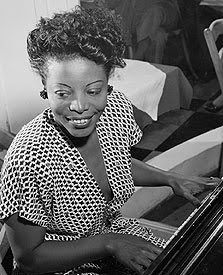
I’d like to introduce you to someone this morning—I say “introduce,” because I imagine many of you won’t be familiar with this person, despite the fact that she was one of the top jazz composers & pianists from the 1930s thru the 1970s. She played blues & swing & bebop & more—including her own wonderful jazz liturgical music after a conversion to Catholicism later in life. She was an arranger for the Duke Ellington band & the Benny Goodman band; she also hung out with the Minton’s crowd: Thelonious Monk, Charlie Parker, Charlie Christian, Kenny Clarke et al.; she composed an extended song cycle called Zodiac Suite that is among the most ambitious of jazz works—she also composed a jazz mass. Yet, her name isn’t well known—her name is Mary Lou Williams. This is what Duke Ellington said of her:
Mary Lou Williams is perpetually contemporary. Her writing and performing are and have always been just a little ahead throughout her career. . . . her music retains—and maintains—a standard of quality that is timeless. She is like soul on soul.
Mary Lou Williams was born Mary Elfrieda Scruggs in Atlanta, Georgia in 1910, but she greup in Pittsburgh, Pennsylvania. She was a child prodigy, gifted with a remarkable ear, & began public performance at age seven, & went on to play with Duke Ellington’s Washingtonians while in her teens. In 1927, she married saxophone player John Williams, & she eventually moved with Williams to Kansas City, where they both joined Andy Kirk’s Clouds of Joy, Williams serving as both pianist & arranger.
Following a divorce from in her husband, Williams moved back east in the early 1940s, first putting together a band in Pittsburgh (with Art Blakely on drums!), then eventually moving to New York. During this time she was composing the magnificent Zodiac Suite & also playing a large role in the development of be-bop. She said:
During this period Monk and the kids would come to my apartment every morning around four or pick me up at the Café after I'd finished my last show, and we'd play and swap ideas until noon or later.
Mary Lou Williams became a convert to Catholicism in the early 1950s, & much of her later music dealt with her new found faith. She said, “I am praying through my fingers when I play. I get that good ‘soul sound,’ and I try to touch people's spirits.” Her Mass for Peace was choreographed by the Alvin Ailey Dance Theater, & performed as “Mary Lou's Mass.” She performed through the 1970s, with her final recording being made at the 1978 Montreux Jazz Festival—in fact, this is available on dvd (as Norman Granz Jazz In Montreux Presents Mary Lou Williams '78), & I recommend it highly; it’s a good introduction to her work. Mary Lou Williams passed away in 1981.
If you’re interested in her work (which I hope!) you have quite a selection from which to choose. My own recommendations (in addition to the Montreux dvd) would include My Mama Pinned a Rose on Me (Pablo); Zoning (Folkways); Zodiac Suite (Folkways); & Black Christ of the Andes (Folkways). There’s also an excellent biography by Linda Dahl titled Morning Glory (University of California Press); I’d also mention that the classic Nat Shapiro/Nat Hentoff compilation Hear Me Talkin’ To Ya (Dover) contains a number of Ms Williams’ reminiscences & anecdotes—this book is a must read for jazz fans.
Happy Saturday, all—& a happy holiday weekend to readers here in the States. As regular readers know, I drove up to Eureka, Montana on Wednesday to see Rory Block perform, & I wanted to share some thoughts & impressions about her performance.
I’ve written about Ms Block in the past on Robert Frost’s Banjo, & it would be accurate to say that I’ve been a great admirer of her work for a number of years; however, in all that time I had never seen her perform live. Eureka, MT is about a 10-hour drive from Indian Valley, but I can assure you, it was worth it!
Actually, I didn’t know what to expect of the venue, which was Lincoln County High School auditorium—but I was pleasantly surprised to find a room with plush theater seats & good, warm acoustics. An audience of roughly 150 people didn’t fill the room, but made a respectable showing; & after all, Eureka is a town of only 1,000 plus folks, with the closest thing to a city, Kalispell, being an hour south.
Rory Block began her set with an impassioned version of Robert Johnson’s “Cross Road Blues,” then moved to an equally fervent cover of Son House’s “Death Letter Blues.” Words like “fervent” are not an exaggeration—Rory Block's guitar playing & singing are passionate, while at the same time displaying a virtuosic skill & technique. One thing that becomes immediately apparent is her uncanny sense of rhythm—the old Delta blues was dance music, & Ms Block’s playing brings that out, especially with the many percussive effects she renders along with her masterful fingerpicking & slide playing. She snaps strings; she beats on the guitar’s soundboard; she uses a heavy damping technique; & all along, she’s stamping out a rhythm with her foot—it’s a powerful & moving display. But the blues is first & foremost a vocal music, & Rory Block is perhaps the most gifted singer I have ever heard live. Her voice often falls in a rich lower range, yet she’s able to employ a clear & strong high range as well: almost the equivalent of a male falsetto, but more full. Obviously, this works extremely well with her material, as many of the great Mississippi blues players were known for their falsetto singing: Robert Johnson, Skip James & Tommy Johnson, just to name a few.
Ms Block performed a 2-hour set of old blues, originals & even a few country tunes, including a remarkable a cappella performance of the old country gospel tune “Daniel Prayed.” At one point, she discussed the long-held distinction between blues as “the devil’s music” & gospel. She observed that for her, there was a continuum—they’re both “spirit music.” Anyone listening to her performance would be convinced that this is true for her; she seems to put her whole being into each song. Yet her performance is never frenetic—she has to be one of the most physically relaxed musicians I’ve ever seen, even when she’s playing at lightning speed or singing an ardent passage.
I’d also have to say that Ms Block is an engaging presence; she interspersed various stories & observations in a relaxed & open manner—funny, moving & sometimes simply “right on.” She also seems very open to her fans & audience—she manned the cd table along with her husband, & talked with folks about how they were learning from her instructional dvds or how they felt about her music & the concert. I got a chance to meet her myself, as well as a signed concert dvd, & this was a great topper to a wonderful evening.
Ms Block was brought to little Eureka, MT by an organization called the Sunburst
Foundation. The group certainly should be applauded for bringing a performer of this stature to a rural western community, just as Rory Block should be applauded for bringing her music to this venue.
I’ve included two videos because I couldn’t settle on one! The first, “Cross Road Blues” is Rory Block inhabiting a Robert Johnson song; the second, “Lovin’ Whiskey” is one of her original compositions. She performed “Lovin’ Whiskey” on Wednesday & told the story behind its composition. I’d always assumed it was based on a true story, & that is indeed the case. It’s such a moving & “real” song.
“Real”—that may be the best way to sum up Rory Block’s music. Hope you enjoy the videos, & if you ever get the chance to see her perform live, please do!