Showing posts with label Women's Art is Women's Work. Show all posts

Any Woman's Blues #1 - Sue Foley

Greetings, folks!  The music continues here on Robert Frost’s Banjo with a brand new series for your listening pleasure. 

When we speak about women & the blues, we tend to think of the great vocalists first.  After all, the first blues recording stars were women like Ma Rainey, Bessie Smith & Ida Cox—it wasn’t until Blind Lemon Jefferson hit the scene that a man achieved similar stardom.  But when we think about blues guitarists—& let’s face it, the guitar is the instrument probably most associated with blues (with apologies to piano players, who could make an argument for the 88s)—women tend to get short shrift.  If you asked the average blues fan to come up with a list of great guitar players you’d probably see names like Robert Johnson, BB King, Lightnin’ Hopkins & Eric Clapton; if the fan was a devotee of old-time blues you’d probably see the likes of Charlie Patton, Son House & Blind Willie McTell on the list.

But the fact is there are lots of extraordinarily talented blues guitar players who also happen to be women.  I’ve often said that I might never have gotten into the blues as a performer were it not for the great Rory Block.  Seeing her perform this spring in Montana was a real highlight of 2010, & I can say that both her playing & singing live were every bit as good as expected.

So we’re going to devote our Saturdays for the foreseeable future to featuring some of these great blueswomen.  Now, you’d think given my high regard for Rory Block, she should be the lead-off feature.  I certainly considered that—& have no fear, she will be featured!—but since I’ve written about Ms Block in the past, I decided I’d start with an artist who hasn’t appeared on this blog before.

& we have a terrific guitar player to get the series underway.  Sue Foley hails from Ottawa, Canada.  She came to music early, & was already performing & composing by her teens.  She left home at age 18 & wound up in Austin, Texas by way of Vancouver & California.  In 1992, still in her early 20s, she released her first album, Young Girl Blues on the Antone label (now on the Discovery label), & has followed this with eleven more albums, most recently He Said, She Said in collaboration with Peter Karp. 

Ms Foley won the Juno Award in 2000 for best blues album for Love Comin’ Down; she’s also a 14 time winner of the Maple Blues Award & a three time winner of the Trophee de Blues de France.  But let’s face it: the proof is in the hearing, & I guarantee Ms Foley won’t disappoint on either of today’s tunes.  I’ve got to say: listening to Sue Foley reminds me why I occasionally have a yen for a Fender Telecaster—listen how she makes her Tele sing!


Blameless Mouth – the Stories We Tell

Poet Jessica Fox-Wilson knows a basic & important truth: we are made of stories.  These are the stories we inherit culturally, the stories of family, the stories we tell about ourselves, the stories told by our peers.  But this poet knows something even more important—we have the ability to re-tell & re-shape those stories, to configure them in line with our own experience & to find a truth in them that isn’t the “received” truth of their packaging.

This is the task Fox-Wilson tackles in her debut collection, Blameless Mouth; she sets herself the task of exploring stories about hunger, consumption, satiety & want both culturally & in her own experience.  These are fundamental issues, speaking both to our overall human condition & more specifically to our situation as members of a consumer society.  But the poet doesn’t stop there.  She also specifically examines how these issues affect her & women in general—at its core, Blameless Mouth is deeply feminist.

Ms Fox-Wilson includes retellings—“re-visions” in a sense—of several important cultural myths.  There are at least a half dozen poems that treat the creation myth & the Eden story, all from Eve’s perspective.  For instance in the poem “Eviction,” which gives a title to the first of the book’s five sections, Eve describes herself as the coolheaded one, while Adam becomes hysterical about their eviction from Eden.  We read:

Even then, as Adam cried
about the loss of home and work and God,
as angels watched us pack, I calculated

our rations, how long we’d remain sated,
how long the fruit would last.

This introduces a theme that is central to the book: the woman’s role as provider, & how that cultural role affects her consumption.  While Fox-Wilson sees the consumerist society as preying on women in terms of body image & self-esteem, she also sees a built-in self-denial faced by women that makes them refuse to satisfy their own wants.  She discusses this most eloquently in the poem “The Day I Learned the Definition of Lacuna.”  Fox-Wilson writes:

    I saw
all the women in my family
who came before me, trimming the fat
off their own meat, slipping the best parts
onto a child’s plate.

This poem & others with a similar thematic concern (especially “Better to Eat Us With,” which I’ve reproduced with Jessica Fox-Wilson’s permission as a companion post) can be read against “Womyn’s Center Topless Spaghetti Dinner,” “Maenads” & “Daughter to Mother.”  The first of these describes a wildly exuberant spaghetti dinner at a Women’s Center, & as such seems to locate a form of healthy consumption in the midst of poems of insatiable want.  “Maenads,” which immediately follows “Womyn’s Center” is a somewhat darker vision of women being free to explore their appetites.  Finally, “Daughter to Mother” is an interesting re-telling of the Persephone/Demeter myth—in this case, Persephone welcomes her Underworld incarnation because the act of consumption has also given her power.

They do not ask anything of me;
their mouths forever shut.  I sit
on my black throne, gorge
on the sight of all
the heavy, full bodies.  I absorb
every nutrient I need
from their forsaken lives.

As in the “Lacuna” poem, again we have a dialogue between mother & daughter.  This poem is preceded by a piece entitled “Things My Mother Did Not Teach Me,” which describes how the poet’s mother could deftly slice an apple.  Apples again—Eve & Snow White, who appears in the poems “Waiting for Snow White” & in the very strong piece, “Inside My Glass Coffin.”  This is again a mother-daughter dialogue in which Snow White’s entombment in the glass coffin is contrasted with the stepmother’s fixation with her mirror.  & at that rate, Snow White’s release by Prince Charming takes on a whole new meaning in Fox-Wilson’s vision:

    I was no more
a beautiful girl, captured in her prime.  I was
like her, a woman imprisoned against her will,
in her own fragile and perishable body.

Blameless Mouth is a strong & engaging collection of poetry, & not simply because of Jessica Fox-Wilson’s willingness to handle deep & compelling themes.  As illustrated by the quotes (& I could go on at length with examples), Fox-Wilson also is skilled in her handling of poetic language.  Here are two more quotes I can’t resist:

Wrap your body in thousand thread count cotton sheets
and you can be the woman, sleeping at home, wrapped
in thousand thread count cotton sheets.
                                    “Magazine Says: You’ve Worked Hard”

                      At the heart of a shipwreck
                                                is a child

staring into a hungry mouth        broken boards/splintered teeth

                                            shiver/sink
                          descend into black depths,
                           learn to breathe water.
                                              "At the Heart of a Shipwreck"
 

This is writing by a poet who has a clear conception of voice, image & rhetoric, who can convey both strong emotion & precise thought. 

I give Blameless Mouth an enthusiastic recommendation.  You can purchase the book on Lulu.com at this link; & don't forget to check out one of the poems from the book, "Better to Eat Us With," in the post immediately preceding this one.  You also can join me in following Jessica Fox-Wilson on her excellent blog, everything feeds process.

"Better to Eat Us With"

[Please enjoy this poem by Jessica Fox-Wilson from her debut collection, Blameless Mouth.  You can read my review of Blameless Mouth in the post immediately following this.]

Better to Eat Us With

I am the granddaughter who wears the red
wool cloak, braves the knotted heart
of the black forest to deliver you warm rye bread
and make certain you are still alive.  I survived

the darkest places, where willows grow curled
and hollow as clutching hands and
hundreds of glowing yellow blink back
at me, from inside prickly mulberry bushes,

only to arrive much too late.  I can see this now
in the hungry yellow eyes and dripping jowls
in front of me.  His hot panting breath curls
the loose tendrils on my bare neck and I know

I must make a new choice.  Grandmother,
I spent my childhood in your kitchen, mixing
your recipes, kneading your dough.  Your daughter,
my mother, has taught me well.  Feed others

before feeding myself.  Listen to your mother’s voice,
not the voice whispering inside.  Look at where
this has gotten us.  You have been made
a more palpable meal and I am staring down

a starving animal dressed in your clothing,
plotting my escape.  I can surrender
and become his second satisfying serving.
But, I cannot bear to live in his belly

with you, praying for some woodsman to deliver us,
whole, slick, and covered in blood, back into this world.
Instead I will swallow a hunk of our bread for strength,
shed my heavy red cloak, and run for our lives.


Jessica Fox-Wilson
© 2010

Intrepid Prop H8 Reporter Audrey Bilger

Happy Thursday afternoon, everyone!  If you’re interested in staying informed on the California Prop H8 decision, you really should stay tuned to our dear friend & sometime collaborator Audrey Bilger over at the Ms blog.  Although this is ancient news by interweb standards, Audrey has recently blogged about the link between Judge Walker’s ruling on the Proposition & how this is furthers the equal status of women—all women, both straight & lesbian—in marriage.  In a fun but informative post yesterday, Audrey compared the Prop H8 ruling to a gothic novel, complete with sinister villains & happy wedding ending.  They’re both must-reads—not just for our LGBT friends but for everyone.

Because, if you also tune in to hear Dr Bilger participate in a roundtable discussion on PRI’s To The Point program, you’ll find out from the pro-Prop H8 speakers that Prop H8 really isn’t so much about gay couples as about straight ones.  Seems like us straight folks might forget to have children if gay marriage is legal.  Dr Bilger, Slate’s Dahlia Lithwick & Jonathan Rauch of the Brookings Institute provide voices of sanity to these & similar arguments—including the statement by William May, Chairman of Catholics for the Common Good that essentially links feminism to the downfall of civilization as we know it.   Brian Brown, Executive Director of the National Organization for Marriage also speaks in support of Prop H8 & decries Judge walker’s ruling.

Please give Audrey’s informative posts a read (here & here) & give the discussion (which starts about 7:40 into the overall program) a listen!  & have a great day.


Update: this afternoon, Audrey posted about Judge Walker's decision today to lift the stay on gay marriages in California as of next Wednesday, August 18th.  You can read Audrey's latest post here.

Sumerian Hymn to the Bridegroom

[Guest post by my wife Eberle—the only person I have ever known who owns a Sumerian grammar.  We’re off to see Natalie Merchant in Washington state.  There will be a Photo of the Week tomorrow, however, as well as the usual Sunday post on The Days of Wine & Roses blog]

I started reading Sumerian poetry and proverbs in translation about a year ago, and also learning a little bit about the language. Never having come across this body of literature before, I was fascinated by a number of things – these writings go back to 5,000 B.C.E., which is almost unimaginably distant to me, but the proverbs seem vividly alive and human:

“This is the fate of the poor man: when he finds bread, he finds no salt. When he finds salt, he finds no bread. When he finds meat, he finds no condiments. When he finds condiments, he finds no meat. When he finds oil, he has no jar to put it in. When he finds a jar, he has no oil.”

Or, something simple and clever to say before lunch: “Bread is the boat, water the punt-pole.”

The holy woman Enheduana lived around 2300 B.C. and wrote about her evolving relationship with the goddess Inanna. Inanna is a fascinating representation of divinity – warrior, bride and courtesan, occasionally male as well as female, the double evening and morning star, in love with a shepherd, mother of the gods, the Lady of Infinite Manifestation; she gave humanity not only language, but knowledge of arts such as weaving. Her journey to the underworld is the first written version of this descent that would be told in many ways for millennia afterwards. Here’s my translation of one of Innana’s Hymns – the way that sacred marriage in this Hymn unites the sensory and the spiritual is beautiful, I think – even inspiring.

Sumerian Hymn to the Bridegroom

Bridegroom, my heart’s beloved
Your body is golden as uncombed honey
Lion, my heart’s beloved
Your body is golden as sweet honey is golden.
You have transfixed me,
My body trembling like a cup of water in my hands.
Bridegroom, I wish you to lead me to the bedchamber,
You have moved my heart, my body trembles,
Like a cup of water lifted in my hands.
Lion, I long for you to lead me to the dais bed.
Bridegroom, I will kiss you
My caresses are more golden than honey in the mouth,
In the bedchamber, hived with honey
I will know your beauty
Lion, I will kiss you
My kisses are more precious than honey.
Bridegroom, we have found the place of delight.
Tell my mother, she will reward you with fruit,
Tell my father, and receive gifts at his hands.
Your spirit—I know where to befriend your spirit.
Bridegroom, sleep in our house until dawn.
Your heart—I know how to delight your heart,
 Lion, stay until dawn touches our house.
You, because you love me,
Give me your kisses. Caress me,
Prince of Love, in the sacred place of delight.
As Shu-sin delights Enlil’s soul,
Let your caresses dwell in me,
Let our meeting be in the place of delight,
Lay your hand on that honeyed place,
Cup your hand over it, caressingly,
Caress it as a silken shift fragrantly
Caresses the skin.

Translation by Eberle Umbach
© 2010


Image is "Inanna," Terracotta relief, Sumer c. 2000 BCE

Agnès Varda - Gleaner of Everyday Life

All film buffs know the French Nouvelle Vague (or New Wave) of course—even more casual enthusiasts are familiar with the works of Goddard, Truffaut, Demy et al.  But there is one of the New Wave who’s still with us, tho she isn’t as well known by the public at large.  That relative obscurity is a shame—at least—because her works are as filled with high artistry & inspiration as those of her more famous colleagues.  That filmmaker is Agnès Varda.


Eberle & I have been on an Agnès Varda spree of late—a whirlwind of beautiful & inspired films.  Actually, until a few months ago, neither of us had seen any of Varda’s films except for Sans toit ni loiVagabond as it’s called in the States or Without Roof or Law (a literal translation) in other English speaking countries.  We both saw the film at Vinegar Hill Theater in Charlottesville, VA; I recall that I found the film beautifully made & powerful—but so powerful as to be harrowing.  Eberle says quite straightforwardly that Vagabond changed her life.  I found it quite interesting that when we saw Varda’s 2008 cinematic autobiography, Les plages d'Agnès (in English, The Beaches of Agnes), she talks about how Sans toit ni loi was born out of rage—rage at the marginalized & oppressed condition of women (it’s telling that Varda discusses the film against a filmed backdrop of women’s rights protests), but also about her marginalization as almost the only woman, along with Marguerite Duras, within French cinema. 

There is no question that Sans toit ni loi is a great film, but it may not be the best introduction to Varda’s work—at least in my opinion (Eberle might disagree with me on this).  During our recent Varda watching spree, we’ve seen La Pointe-Courte (Varda’s debut film in 1955), L'opéra-mouffe (The Diary of a Pregnant Woman, 1958), Cléo de 5 à 7 (Cleo from 5 to 7 from 1962), Les glaneurs et la glaneuse (The Gleaners & I, 2002) & Les plages d'Agnès.  In these films we were struck by Varda’s focus on the ordinary objects & appurtenances of everyday life—her eye for detail—& a focus that can morph readily from surreality to candid realism.  Varda’s films also celebrate process, whether following the real time movement of a woman awaiting a possibly serious diagnosis in Cléo de 5 à 7 or her detailing the process of gleaning in Les glaneurs et la glaneuse—in case you don’t know, gleaning is picking up what is left over after a harvest.  & despite her treatment of serious themes, her films are always inviting to watch.

Agnès Varda began her artistic career as a photographer, & you can see this background in the composition of her shots—many stills from her films would be art photographs in their own right.  She combines this with a thorough feminist vision & a fierce love of life combined with a keen sense of social justice.  I’ve added four clips from her films—I know that’s a lot, but I’ve selected short ones (& sorry—the definition on the Vagabond clip isn’t so great.)  The clips should give at least some sense of these characteristics.

Some of Ms Varda’s 47 films are available on DVD.  The Criterion Collection has issued a must have set called 4 by Agnès Varda (La Pointe Courte, Cléo from 5 to 7, Le bonheur, Vagabond), & The Beaches of Agnes, The Gleaners & I & Vagabond also are available.  All of these except for Le bonheur are also current NetFlix selections.

Hope you find the clips intriguing, & please do check out the marvelous films of Agnès Varda.


“Into the Trees”

Happy Monday all!  & it’s another musical Monday here on Robert Frost’s Banjo, tho I am taking the week off from the Monday Morning Blues—I like to mix things up just a bit!  & in that spirit, I’m presenting you with some music you may not know but I think you’ll find intriguing.  That’s the music of cellist Zoë Keating, whose second album Into the Trees was released in June.

It’s a wonderful album, simply put—a series of 11 soundscapes with richly layered sound, gorgeous melodies & harmonies & shifting rhythms—& such rich layering is possible because Ms Keating has constructed multiple tracks, so that she becomes a one-woman cello orchestra.  As a studio production, this would be impressive in itself—however, Zoë Keating is able to reproduce these performances live by simultaneously playing two instruments: her cello & a MacBook Pro.  In the second video below, Ms Keating explains her looping technology in an interview with Wired.  Suffice it to say that Zoë Keating’s compositions are all of a piece, from the melodic lines to the percussive effects.

The compositions themselves are the kind of music that seems at once familiar & completely fresh—the music one might hear in a dream—you believe you know it, & yet in the light of day, you realize you’ve never heard anything quite exactly like it, it seems, too, both ancient & modern.  This is “classical” music, for all its indebtedness to more contemporary sounds—but classical music that could be comfortable in any number of surroundings—from concert hall to dance club.  

The music is also narrative in the best sense of the word—it moves us to different points on an emotional spectrum while all the time leaving space for our own; they allow for stories without insisting on them.  Another way of saying this is that Ms Keating’s music is like the river that’s changed each time you step into it.  It shouldn’t be surprising, given this characteristic, that Zoë Keating has also composed several film soundtracks as well as ballets.

Listening to music that’s built on a looping foundation, like Zoë Keating’s or that of guitarist Matt Stevens, puts me in mind of one of my favorite jazz artists, Rahsaan Roland Kirk.  It’s not that the music itself—the melodies, harmonies & rhythms
are similar, but that Kirk, like these performers, was literally a one-man orchestra.  Because of his mastery of circular breathing, he could play three wind instruments simultaneously.  Some dismissed this as gimmickry, but to me, Kirk was the proptype one-person orchestra—different than a one-man-band in that the overall effect becomes symphonic—tones melded together in a harmonious whole, yet distinct in themselves—tones that create a complex aural vision.

Ms. Keating’s album (as well as her first album, One Cello x 16: Natoma) are available from her website, both as an actual cd & as digital downloads; her music is also available on iTunes.  Hope you enjoy “Escape Artist” (the first video below) & stick around to listen to Ms Keating’s interview with Wired (also set to her music!)


What’s Your Story, Morning Glory – The Music of Mary Lou Williams


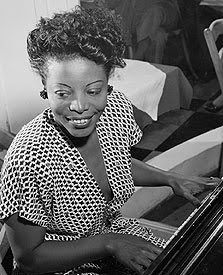
I’d like to introduce you to someone this morning—I say “introduce,” because I imagine many of you won’t be familiar with this person, despite the fact that she was one of the top jazz composers & pianists from the 1930s thru the 1970s.  She played blues & swing & bebop & more—including her own wonderful jazz liturgical music after a conversion to Catholicism later in life.  She was an arranger for the Duke Ellington band & the Benny Goodman band; she also hung out with the Minton’s crowd: Thelonious Monk, Charlie Parker, Charlie Christian, Kenny Clarke et al.; she composed an extended song cycle called Zodiac Suite that is among the most ambitious of jazz works—she also composed a jazz mass.  Yet, her name isn’t well known—her name is Mary Lou Williams.  This is what Duke Ellington said of her:

Mary Lou Williams is perpetually contemporary. Her writing and performing are and have always been just a little ahead throughout her career. . . . her music retainsand maintainsa standard of quality that is timeless.  She is like soul on soul.

Mary Lou Williams was born Mary Elfrieda Scruggs in Atlanta, Georgia in 1910, but she greup in Pittsburgh, Pennsylvania.  She was a child prodigy, gifted with a remarkable ear, & began public performance at age seven, & went on to play with Duke Ellington’s Washingtonians while in her teens.  In 1927, she married saxophone player John Williams, & she eventually moved with Williams to Kansas City, where they both joined Andy Kirk’s Clouds of Joy, Williams serving as both pianist & arranger.

Following a divorce from in her husband, Williams moved back east in the early 1940s, first putting together a band in Pittsburgh (with Art Blakely on drums!), then eventually moving to New York.  During this time she was composing the magnificent Zodiac Suite & also playing a large role in the development of be-bop.  She said:

During this period Monk and the kids would come to my apartment every morning around four or pick me up at the Café after I'd finished my last show, and we'd play and swap ideas until noon or later.
Mary Lou Williams became a convert to Catholicism in the early 1950s, & much of her later music dealt with her new found faith.  She said, “I am praying through my fingers when I play.  I get that good ‘soul sound,’ and I try to touch people's spirits.”  Her Mass for Peace was choreographed by the Alvin Ailey Dance Theater, & performed as “Mary Lou's Mass.”  She performed through the 1970s, with her final recording being made at the 1978 Montreux Jazz Festival—in fact, this is available on dvd (as Norman Granz Jazz In Montreux Presents Mary Lou Williams '78), & I recommend it highly; it’s a good introduction to her work.  Mary Lou Williams passed away in 1981.

If you’re interested in her work (which I hope!) you have quite a selection from which to choose.  My own recommendations (in addition to the Montreux dvd) would include My Mama Pinned a Rose on Me (Pablo); Zoning (Folkways); Zodiac Suite (Folkways); & Black Christ of the Andes (Folkways).  There’s also an excellent biography by Linda Dahl titled Morning Glory (University of California Press); I’d also mention that the classic Nat Shapiro/Nat Hentoff compilation Hear Me Talkin’ To Ya (Dover) contains a number of Ms Williams’ reminiscences & anecdotes—this book is a must read for jazz fans.

Hope you enjoy Mary Lou Williams’ music!


Spirit Music: Rory Block in Eureka, MT 6/30/10

Happy Saturday, all—& a happy holiday weekend to readers here in the States.  As regular readers know, I drove up to Eureka, Montana on Wednesday to see Rory Block perform, & I wanted to share some thoughts & impressions about her performance.

I’ve written about Ms Block in the past on Robert Frost’s Banjo, & it would be accurate to say that I’ve been a great admirer of her work for a number of years; however, in all that time I had never seen her perform live.  Eureka, MT is about a 10-hour drive from Indian Valley, but I can assure you, it was worth it!

Actually, I didn’t know what to expect of the venue, which was Lincoln County High School auditorium—but I was pleasantly surprised to find a room with plush theater seats & good, warm acoustics.  An audience of roughly 150 people didn’t fill the room, but made a respectable showing; & after all, Eureka is a town of only 1,000 plus folks, with the closest thing to a city, Kalispell, being an hour south. 

Rory Block began her set with an impassioned version of Robert Johnson’s “Cross Road
Blues,” then moved to an equally fervent cover of Son House’s “Death Letter Blues.”  Words like “fervent” are not an exaggeration—Rory Block's guitar playing & singing are passionate, while at the same time displaying a virtuosic skill & technique.  One thing that becomes immediately apparent is her uncanny sense of rhythm—the old Delta blues was dance music, & Ms Block’s playing brings that out, especially with the many percussive effects she renders along with her masterful fingerpicking & slide playing.  She snaps strings; she beats on the guitar’s soundboard; she uses a heavy damping technique; & all along, she’s stamping out a rhythm with her foot—it’s a powerful & moving display. But the blues is first & foremost a vocal music, & Rory Block is perhaps the most gifted singer I have ever heard live.  Her voice often falls in a rich lower range, yet she’s able to employ a clear & strong high range as well: almost the equivalent of a male falsetto, but more full.  Obviously, this works extremely well with her material, as many of the great Mississippi blues players were known for their falsetto singing: Robert Johnson, Skip James & Tommy Johnson, just to name a few.

Ms Block performed a 2-hour set of old blues, originals & even a few country tunes, including a remarkable a cappella performance of the old country gospel tune “Daniel Prayed.”  At one point, she discussed the long-held distinction between blues as “the devil’s music” & gospel.  She observed that for her, there was a continuum—they’re both “spirit music.”  Anyone listening to her performance would be convinced that this is true for her; she seems to put her whole being into each song.  Yet her performance is never frenetic—she has to be one of the most physically relaxed musicians I’ve ever seen, even when she’s playing at lightning speed or singing an ardent passage.

I’d also have to say that Ms Block is an engaging presence; she interspersed various stories & observations in a relaxed & open manner—funny, moving & sometimes simply “right on.”  She also seems very open to her fans & audience—she manned the cd table along with her husband, & talked with folks about how they were learning from her instructional dvds or how they felt about her music & the concert.  I got a chance to meet her myself, as well as a signed concert dvd, & this was a great topper to a wonderful evening.

Ms Block was brought to little Eureka, MT by an organization called the Sunburst

Foundation.  The group certainly should be applauded for bringing a performer of this stature to a rural western community, just as Rory Block should be applauded for bringing her music to this venue. 

I’ve included two videos because I couldn’t settle on one!  The first, “Cross Road Blues” is Rory Block inhabiting a Robert Johnson song; the second, “Lovin’ Whiskey” is one of her original compositions.  She performed “Lovin’ Whiskey” on Wednesday & told the story behind its composition.  I’d always assumed it was based on a true story, & that is indeed the case.  It’s such a moving & “real” song.

“Real”—that may be the best way to sum up Rory Block’s music.  Hope you enjoy the videos, & if you ever get the chance to see her perform live, please do!


“Gertrude Stein”


Hi, folks! Having spent the morning booting & re-booting the computer in various attemots to solve performance issues (nothing too major, but all annoying at least), I am finally here with our Final Thursday featured poem.

We’re bringing our two-month look at Mina Loy to a close today with a short poem that Loy wrote in the early 1920s as a tribute to Gertrude Stein. Mina Loy was an active member of Stein’s salon, & was close friends with many of the artists & writers who congregated chez Stein. Gertrude Stein paid Loy a high compliment in her Autobiography of Alice B Toklas, when she wrote, "Mina Loy . . . was able to understand without the commas. She has always been able to understand." There was a great deal of mutual respect between Stein & Loy—interesting, because they are unquestionably two of the most important yet misunderstood writers from the “Modernist” period.

If you’re not familiar with the work of Loy & Stein, please do yourself a favor & check them out. Loy’s poems are fortunately in print, as The Lost Lunar Baedecker, while Stein’s works are readily available. A good introduction to Stein (I think) would be either Three Lives or The Autobiography of Alice B Toklas.

Featured poet for July & August? Robert Creeley. But for now, enjoy these lines about Gertrude Stein—& consider in what ways they are about Loy as well!

Gertrude Stein

Curie
of the laboratory
of vocabulary
        she crushed
the tonnage
of consciousness
congealed to phrases
        to extract
a radium of the word

Mina Loy

“Mexican Desert”


Happy Thursday! This month’s featured poet will be one of my personal favorites, & a writer who deserves to be more widely read, Mina Loy. Ms Loy was British by birth (1882), but later lived on the continent, both in France, where she was a regular at Gertrude Stein’s salon, & a good friend of both Stein & Djuna Barnes, & later in Italy, where she was connected with the “Futurist” movement thru her lover, Filippo Marinetti. She moved to New York in 1916, & was connected with Others magazine. Loy’s poetic star shone quite brightly for some time—she was both praised & notorious—her great poem, Love Song to Johannes was attacked as pornographic, tho to my mind it’s one of the great 20th century poetic works. Around the time today’s poem was published in The Dial, Ezra Pound (in one of his patented literary “remarks”) asked Marianne Moore, “is there anyone in America except you, Bill [William Carlos Williams] and Mina Loy who can write anything of interest in verse?”

But Loy’s reputation was eclipsed, much to the puzzlement of some writers. In 1957, Henry Miller described her as “an interplanetary voice whose subtle vibrations only faintly pierce our smug-laden atmosphere”; in 1982, critic Hugh Kenner noted, “her utter absence from all canonical lists is one of modern literary history’s most perplexing data.” Her exclusion from the “who’s who” of modernists was also lamented by writers like William Carlos Williams, Kenneth Rexroth & Louis Zukofsky. Fortunately, Loy’s work has been revived over the past 20 years, & now it’s possible to purchase her poems without much ado.

Hope you enjoy today’s poem—it captures the condensed language that—in my opinion—Loy had perfected in Love Songs to Johannes. That long poem was published in 1917; “Mexican Desert was published in 1921, & probably written some time between 1919 & 1921.

Mexican Desert

The belching ghost-wail of the locomotive
trailing her rattling wooden tail
into the jazz band sunset

The mountains in a row
set pinnacles of ferocious isolation
under the alien hot heaven

Vegetable cripples of drought
thrust up with parching appeal
cracking open the earth
stump-fingered cacti
amid hunch-back palm trees
belabour the cinders of twilight

Mina Loy

In other news: There won't be any post tomorrow, but I should be back for Sepia Saturday. I also may not have access to respond to comments until later in the day on Friday!

Hot Cockles in the Pantry

[Here’s Eberle’s examination of pantries!]

In kitchens without plastic wrap, bags, or containers, without refrigerators and freezers, food storage took up a great deal of time. It took up space too. Instead of a single room housing all kitchen activities, several rooms were designated for food storage and preparation: larder, buttery, pantry. Each had a different purpose.

The larder originally served to store meats—
salted, smoked, or partially cooked and kept in barrels of lard. In Medieval times, huge quantities of preserved meats were kept in multiple larders. As the need for storing large amounts of meat disappeared (few nineteenth century households anywhere were storing 50 – 100 deer carcasses at a time) larders changed their nature to some degree although they kept their name. Rural families still butchered in the fall when the weather was cold and the meat would keep the longest. They made use of traditional preservation methods—salting, drying, smoking, storing in brine or lard, and sausage-making—but on a smaller scale. A single farm family could not consume all the fresh meat from a large slaughtered animal before much of it went bad. However, in urban areas or places with large regional markets, animals could be slaughtered and the meat sold fresh before it spoiled. As meat became regularly available year-round to separate family residences, the larder shrank and became home to other food items such as cheese as well as meat. To keep the larder cool, householders located it on the north side of the main dwelling. Sometimes the larder, as a small room or simply a cupboard, contained a screened window open to the outside to allow for air circulation.

The word buttery originally referred to butts (or pipes—units of measurement) of ale and wine.
Casks of cider, ale, and stronger spirits were kept, ideally, in a cool, dry, dark place, and by the nineteenth century, the buttery had become the wine cellar. Here the master of the house could pride himself on his knowledgeable choice of wines —and demonstrate the length of his purse to his dinner guests. The rather pig-headed archdeacon in Barchester Towers is not shy about holding forth on the subject during a visit that included a tour of the wine cellar: “This cellar is perfectly abominable. It would be murder to put a bottle of wine into it till it has been roofed, walled, and floored. How on earth old Goodenough ever got on with it, I cannot guess. But then Goodenough never had a glass of wine that any man could drink."

The cellar makes special appearances in gothic tales as well. In Edgar Allen Poe’s The Cask of Amontillado, a host murders a guest by luring him to the cellars beneath the house, promising a taste of a rare wine and pretending to want the guest’s opinion of it. Instead of presenting him with the promised sherry, the host walls his guest up alive in a niche in the cellar, stopping his work occasionally to listen to the doomed man’s screams.

Things like this just didn’t tend to happen in the pantry. The nineteenth century home provided
an architectural division of the sexes, and the cellar was excluded from the female realm. The housekeeper held the keys to many doors and cupboards, but the butler kept a firm grip on the keys to the wine cellar. The pantry, the larder, the linen closet—this was the province of women, described by Susan Ferrier in Marriage: “Their walk lay amongst threads and pickles; their sphere extended from the garret to the pantry.”

The word pantry comes from the Latin word for bread, panis, and originally the pantry was the room where bread was kept. Also the ingredients for making it and for waging the battle against mice and rats that inevitably ensued. Over time the pantry took on multiple identities—it could be a cool room separate from the kitchen where some food, especially leftovers, were stored, and it became a storage area for china and glassware as well. Pantries were not merely shelves for storage, as they often are today, but self-contained rooms where a variety of activities could take place. Provisions could be unpacked there and a housekeeper could sit and have a snack in comfort. A festive treat for a housemaid in Lady Morgan’s Wild Irish Girl is “a game of hot cockles with the butler and footman in the pantry.”

The Game of Hot Cockles
A Penitent chosen by chance, or by his own choice, hides his face upon a lady’s lap, which lady serves as Confessor, and places herself in an armchair in the midst of the company. The Penitent places his hand behind him, —not on his back, which might be dangerous if the person who is to hit it should forget the proper moderation, but on his hips. Then a lady or a gentleman hits this hand and the owner of the hand has to guess who struck. If he succeed, the person he guessed is to take his place; if he is mistaken, he goes on till he has shown more penetration.
Catharine Harbeson Waterman, The Book of Parlor Games 1853

A specifically masculine version of the room evolved in the nineteenth century, distinguished
from women’s territory by its name: the butler’s pantry. The butler’s pantry served mainly as a storage place for the more valuable china and silver, and also as a staging area near the dining room where the butler could decant wines, add last-minute garnishes, and heat chafing dishes. A good arrangement of these storage and preparation areas was essential to the harmony of the household in Jane Austen’s opinion. In Emma she mentions the “inroads on domestic peace to be occasioned by no housekeeper's room, or a bad butler's pantry.”

In 1869, Harriet Beecher Stowe chided men and women both for wasting so much space in extra rooms like pantries when storage and prep areas could so easily be incorporated into the kitchen itself. Harriet gives detailed plans for how this could be done in The American Woman’s Home. Her designs look very much like one of today’s kitchens, though her concept did not catch on in any general way until the next century.

In spite of Harriet’s pleas, the pantry persisted in being a room of its own—perhaps women had an incentive besides utility in preserving this often exclusively female space. Women could retreat to the pantry with the excuse of household business, and find a legitimate escape from the social or conjugal duties associated with almost all other spaces in the house. A solitary refuge, a place where women reigned, the kitchen pantry was where Emily Dickinson wrote parts of her poems. One of tasks performed daily in her household was filling the lamps with whale oil—a shelf in the pantry was devoted to this use.

As the master of the house might pride himself on his wine cellar, the mistress took pride in her
arrangement and operation of the pantry. Women were charged with preserving civilized order and decorum as well as fruit, and the pantry was guarded as a feminine sanctum that stood for more than jam. Louisa May Alcott describes a grandmother who “stood in her pantry like a culinary general, swaying a big knife for a baton, as she issued orders and marshalled her forces.” The pantry generals were not always successful in protecting their territory from invasion. Pantry raids became a stock feature of nineteenth century children’s literature—and boys were almost always the culprits. One of the most famous of these raids is Tom Sawyer’s theft of jam in Aunt Polly’s pantry; outraged, she assigned him the task of whitewashing her fence as a punishment for his transgression.

Eberle Umbach
© 2007-2010

Pix from Top:
[Note: I realize most of these images all come from a time before the era Eberle's writing about, but has there ever been more magnificent food painting than in the 17th century?]
The Pantry: Franz Snyders, 1620
Stilleleben: Albrecht Kauw, 1678
The Way You Hear It: Jan Steen, 1665
Still-Life with Cheese: Joris van Son, 1650s
Der verlorene Sohn (The Prodigal Son): Gerard van Honthorst, 1623
Besuch bei einem Lord: Pietro Longi, 1746
Stilleleben: Floris Claesz van Dyck, 1618


submit to reddit

How To Undress After a Ball

[Here's a fictional piece by Eberle about Jane Austen for your enjoyment]

You step outside into the night and you are Jane Austen. The carriage is waiting to take you back to the London house of friends you are visiting—they have a reputation to maintain and insisted on sending the carriage, with family crest emblazoned on the door and winking at you in the lamplight. You note, through the carriage window, the illuminated house fronts passing like stage scenery—you don’t visit the metropolis often enough to have lost interest in such things. The carriage jolts over a gap in the cobblestones; after six hours in a hot and crowded ballroom you have a sudden memory of standing underneath the big elm at home, the way its boughs disappear into the night sky as you look up into it, the bell of coolness descending from it like an old-fashioned hoop skirt.

The Lady of the house where you are staying has directed the servant to leave a tray for you in the parlor. You’re not hungry but out of politeness you do eat and then light your own way upstairs to your room holding a candle in one hand and the skirt of your gown in the other. Unlike your titled hostess, your grand gestures must be inward and verbal rather than material
and you are careful not to drip candle wax on your ball dress—you can’t afford to buy another this season, and you do think that this gown is particularly successful, the pale blond mesh overdress giving dimension to the white muslin beneath, as well as masking any slight discoloration-- an economical arrangement. The unfamiliarity of the house passes through you with a shiver and the ballroom conversation goes jangling through your head—it is your curse to remember every word of it no matter how absurd or cutting. Your sister isn’t with you on this visit and you are aware of how alone you feel. Not that you would be able to tell the heart of your thoughts even to her. You never do, not entirely. You would not tell her that tonight you kept thinking: How would the music be sounding to me if he had come, what would dancing feel like if he were in the room?

The Lady has asked Mary, her own maid, to help you undress and she is asleep in a chair by the armoire that looms in a shadowy corner. She wakes up when you walk in and you give her a
moment to collect herself, depositing your gloves and fan on the dressing table. You remove the small twist of fresh flowers from the neckline of your gown where it is pinned securely into the stiff material of the short stays you are wearing. The pincushion on the dressing table is mounted snugly into a small silver boat and makes you think of your visit earlier in the week to Kew Gardens—the Lake, the Chinese Pagoda, and the Temple of Solitude.

Mary takes over as you are unfastening the front of your net overdress—the delicate mesh could be easily torn. She asks you if it was a lovely ball as she unpins the outer sleeves and you say
that it was a lovely ball as you hold your arms outstretched for the removal of the sleeves. You think it’s quite effective the way the gauze opens in places caught up with small silver pins, nothing heavy. You smile to think of all of the girls of good English family playing at being Grecian nymphs in this way—but if it is to be done, it should be done gracefully and not to the point of the ridiculous. Those ornate Grecian headdresses for instance on display right now on Bond Street, tempting as they look, could not be worn by ninety-nine girls out of a hundred—as the Metcalfe girl proved so distressingly this evening. The first pale blond sleeve laid out on the dressing table looks strangely lifeless, reminding you of the shed skin of a dragonfly nymph you saw at Kew Gardens on a rock by the miniature lake; the creature had simply crawled away from its skin forever with an enviable disregard for the proprieties. Does he ever go to Kew Gardens when he is in town, has he seen Captain Bligh’s breadfruit and the African water lilies?

After the overdress and gown are laid aside, Mary unhooks your petticoat. The one thing you
miss about the fashions of your younger years is pockets—you smile remembering the elaborate embroidery you and your sister executed on pockets for each other, the pleasure of such fancy-work worn where no one else would ever see it. You will send Mary off to bed soon but not until she has her reward for sitting up and hears about the food, you know she enjoys these details and her Lady doesn’t get out much anymore. So you tell her of the tower of pineapples, the jasmine and elderflower ices colored pink and moulded into the shape of crayfish. To yourself in the mirror, however, you convey your opinion of the vulgarity of this display through a faintly arched eyebrow. You would have aimed it at your sister had she been there and she would have read your expression as easily as if the words were written in a book. What a luxury it is, you think, the presence of an understanding mind. Would it be like that, if one were living with him always? That shared ease? Mary loosens and removes your short stays, and there it is—the familiar sense of relief that always comes when they are removed, though they are not particularly tight or heavy.

When the maid turns away carrying all your finery in her arms and there is only a chemise
between you and the world, you turn to the dressing table mirror. You are Jane Austen. When you look at yourself in the mirror, you don’t examine the shadows under you eyes, or wonder if you should have risked just a little rouge. Instead, you remember all the moments this evening that you retained, without arrogance, your code of behavior. He once told you that your being had the invincible clarity of a perfectly carved cameo.

Mary returns from the armoire holding a dressing gown and when you are wrapped in this you sit down at the dressing table to take off your shoes and untie the garters that secure your
stockings just below the kneeyou have to tie them quite tightly when you are planning to dance. You tell Mary that you will take down your hair yourself and that she may go. It’s odd, you can’t tell if she’s disappointed or relieved—but that is proper behavior in a well-trained servant.

Now you remove the combs and pins from your hair, and look without flinching into those eyes in the mirror: how did your self-respect survive the ravages of a long night spent in mixed company? At times quite mixed, you reflect, remembering the man (insufferable puppy, your brother would say) who kept pressing you to dance even after you had refused him. It is possible, you realize with a wry smile, that boorishness does not recognize when it is crushed by impeccable politeness, but crushed it is. Having refused him, etiquette forbids you to accept another partner for that dance and your own self-respect forbids you to appear ruffled. How intimately you came to know every detail of that candle-sconce reflected in its mirror on the wall across the room, sitting out that dance.

You then allow yourself one sentimental gesture—you take a dianthus from the bouquet you laid
aside earlier, the one whose astringent spice he once said made him think of you. You separate it from the others and lay it next to the dressing case where you can look at it as you brush your hair. Not orange blossom, he had said, not for you. Careful, you tell yourself, mind your equanimity, there is danger here. A vertigo. You focus on the red fringe of a petal, the almost imperceptible curve that is honing inward toward its heart. When you are done brushing your hair you absentmindedly reveal that your breeding is not of the very best by removing the hair tangled in the bristles yourself rather than leaving this for the maid to do. You place the tangled nest into the hair receiver on the dressing table.

You tip the perfume bottle to gauge its contents. No one seems to be wearing Eau Divine anymore, you must tell them at home when you write next. Your mother gave you this perfume bottle before you left, an unusual gesture for her, and although you don’t feel a rush of affection exactly, you find yourself thinking of her dancing in her youth; it was her perfume bottle, and this fact reminds you that she too has known this moment. You see a hall of mirrors, an image of endless ball-going girls in white muslin. In a sense the whole thing is pathetic. On the other hand, you note, the sensation that you are flying during a waltz, that all time is suspended and all eyes centered on you with admiration is equally true.

That bouncing creature in the Grecian headdress keeps intruding on your thoughts—and you tell yourself that if you don’t stop thinking of her you will have to wonder if perhaps you are jealous of her apparent contentment. And you were a bit of a fool over that conversation at the punch table as well. You reposition a pin in the cushion with a precise stab. Was it right to speak as if you had no feeling for nature at all? It is simply so unbearable when they gush over poetry as if its purpose were to describe a new color they could all paint their carriages. And yet, of course, the feeling you have about that is no more than pride. Your besetting sin, the one you will most have to account for—but there’s no sense in becoming morbid. If God gave you pride He must deal with the consequences. You do try. You open a jar and sniff at a preparation of cucumbers a friend gave you before smoothing it lightly into the skin around your eyes.

You linger over your final gesture at the dressing table, which is to remove the teardrop earrings
from your ears. Do you let yourself think of him now that the night has reached a point of stillness, open, like the center of the water lilies you saw at Kew Gardens? Does he ever go to Kew Gardens, what would it be like to meet him there, to walk with him in the shadowy labyrinths? You spend a moment imagining the boutonniere he would have chosen for the ball tonight. It would reflect a refined taste, a lack of show. Yet also convey an understanding of beauty. Somehow he is able to indicate that to youyour own inner secret—and it is shocking in a way to think that another person might share that country. What you never speak of. What saves you, and also what breaks your heart in secret. What makes the counterweight to duty, restraint, detachment: the light in the leaves, suddenly alive, the balance of color in the sky. Now the horizon turns into the line of his shoulders, so familiar, so exotic. Now you let yourself remember that one glimpse of the sky through the leaves of the elm when he kissed you. A part of you stood slightly to one side, knowing that piece of sky would remain with you forever even if you never saw him again. You place the earrings into their small velvet box and close the lid.

Eberle Umbach
© 2007-2010

Riddle Me This

[Happy Sunday everyone! In this post, Eberle examines some old-time holiday entertainment. Hope you enjoy it!]

Imagine Christmas without movies or vacation packages to Las Vegas, without video games or trips to the mall to keep the younger generation occupied. Though perhaps more stay-at-home in the past, celebrations of Christmas were not necessarily idyllic. Mrs. Oliphant in her 1893 novel Hester takes Charles Dickens to task for his sentimentalized rendering of the family Christmas. It may strike modern readers as almost shockingly contemporary to hear Mrs. Oliphant refer to Christmas as that “often troublesome festival” and go on to say:

The amount of reality in the rejoicings may be very doubtful, but yet there must be a family gathering, and the different branches of the race must seem to take kindly to it whatever may be their private sentiments. Dickens did wisely in finding his types of Christmas felicity among people to whom an accidental turkey is a benediction from heaven, and the mystery of the pudding has not lost its freshness.
The apparent simplicity of a nineteenth century Christmas might seem attractive, but keeping
family groups occupied still presented a challenge.

I presume you are now all come home for the holidays, and that the brothers and sisters and cousins, papas and mammas, uncles and aunts, are all met cheerfully round a Christmas fire, enjoying the company of their friends and relations, and eating plum pudding and mince pie. These are very good things; but one cannot always be eating plum pudding and mince pie: the days are short, and the weather bad, so that you cannot be much abroad; and I think you must want something to amuse you. Besides, if you have been employed as you ought to be at school, and if you are quick and clever, as I hope you are, you will want some employment for that part of you which thinks, as well as that part of you which eats; and you will like better to solve a riddle than to crack a nut or a walnut…
Anna Laetitia (Aikin) Barbauld, A Legacy for Young Ladies (1826)

Riddles, published in magazines or books or passed along by word of mouth, made up a popular
past-time in the nineteenth century.

"Four stiff-standers, four down-hangers,
two crook-abouts, two look-abouts, and a whisk-about."
"Eh! who couldn't guess that?---it's nothing but a cow…"
"Through a riddle and through a reel,
Through an ancient spinning wheel---
Through the grass and in the skies,
If you guess this you'll be wise."
"Well, then, I am wise, for it's frost," replied Sally; but I doubt whether she could have come to this conclusion so readily from any meaning of the words. "Now I'll tell one you can't guess:
`Long legs, short thighs,
Little head, and no eyes."'
"Tongs, tongs!" shouted Jane Anne.
Alice Cary, Clovernook, or Recollections of our Neighborhood in the West (1853)

Every Family’s Book of Amusement (London, 1853) recognized the importance of
entertainment in the family domestic circle. In the winter, especially in country towns, visiting became impossible for days at a time and families had to amuse themselves at home. Every Family’s Book of Amusement contains rules for card games as well as backgammon, chess, dominoes, checkers. Sleight-of-hand and card tricks were described as well as a wide variety of word games. An example of an enigma:

“Five simple letters do compose my frame;
And, what is singular, when viewed, my name
Forwards and backwards will be the same
When I’m discovered you will plainly see
What the proud peer and peasant soon will be.” (Solution: Level.)

An example of a conundrum:

“What is that which is too much for one, enough for two, but worse than nothing for three?” (Solution: A secret.)

Charades are given in the book as well, for domestic entertainment; in the nineteenth century, charades took the form of verse, with one player acting out each syllable of the word:

“My first your sleepy head attends;
My second names your dearest friends;
My whole’s oft at your fingers’ ends.” (Solution: Nap-kin.)

Women writers in the nineteenth century often incorporated these word games in their books. Beatrix Potter, in The Tale of
Squirrel Nutkin, presents this riddle:

“A house full, a hole full, and you cannot gather a bowl full.” (Solution: Smoke.)
Jane Austen makes use of riddles and charades in her novels as well. In Emma, the following “well-known” charade appears:

My first doth affliction denote
Which my second is destin'd to feel.
And my whole is the best antidote
That affliction to soften and heal.
(First syllable, woe; second syllable, man; solution: “woman.”)

Eberle Umbach, © 2007-2009


submit to reddit